Long-Term Care • Retirement Planning • Healthcare Costs
How to Plan for Long-Term Care Without Derailing Your Retirement
3 Key Takeaways
1
Long-term care can include help at home, assisted living, memory care, or nursing-facility care. It does not always mean spending several years in a nursing home.
2
Because the timing and duration of care are uncertain, it is usually more useful to test several possible scenarios than to assume one worst-case outcome.
3
WealthTrace can help you model care costs, inflation, insurance benefits, taxes, and separate scenarios for each spouse.
Want to see how long-term care could affect your retirement plan?
Use WealthTrace to test home care, assisted living, nursing-facility costs, insurance benefits, inflation assumptions, and funding sources before care is needed.
Start Free Trial
Model long-term care scenarios in your retirement plan.
Long-term care is one of the most uncertain retirement expenses. You may never need paid care, you may need part-time assistance at home for a limited period, or you may eventually require assisted living, memory care, or full-time nursing care.
The Administration for Community Living estimates that someone turning 65 has almost a 70% chance of needing some form of long-term services and support during their lifetime. However, approximately one-third may never need care, while about 20% may need it for longer than five years.
That wide range makes it difficult to choose one assumption. You cannot know exactly when care may begin, what type of help will be needed, or how long it will last. The goal is not to predict the future perfectly, but to understand how several reasonable outcomes could affect your retirement plan.

Long-Term Care Does Not Always Mean a Nursing Home
Long-term care generally refers to help with daily activities such as bathing, dressing, eating, preparing meals, taking medication, or moving safely around the home.
Care may be provided:
- At home by family members or paid caregivers
- Through an adult day-care program
- In an assisted living or memory-care community
- In a nursing facility
Many people receive at least some care at home, and their needs may increase gradually rather than beginning with an immediate move to a facility. This is why automatically entering several years of nursing-home expenses may overstate the most likely outcome.
A more balanced plan could include limited home care, a moderate assisted-living scenario, and a higher-cost stress test.
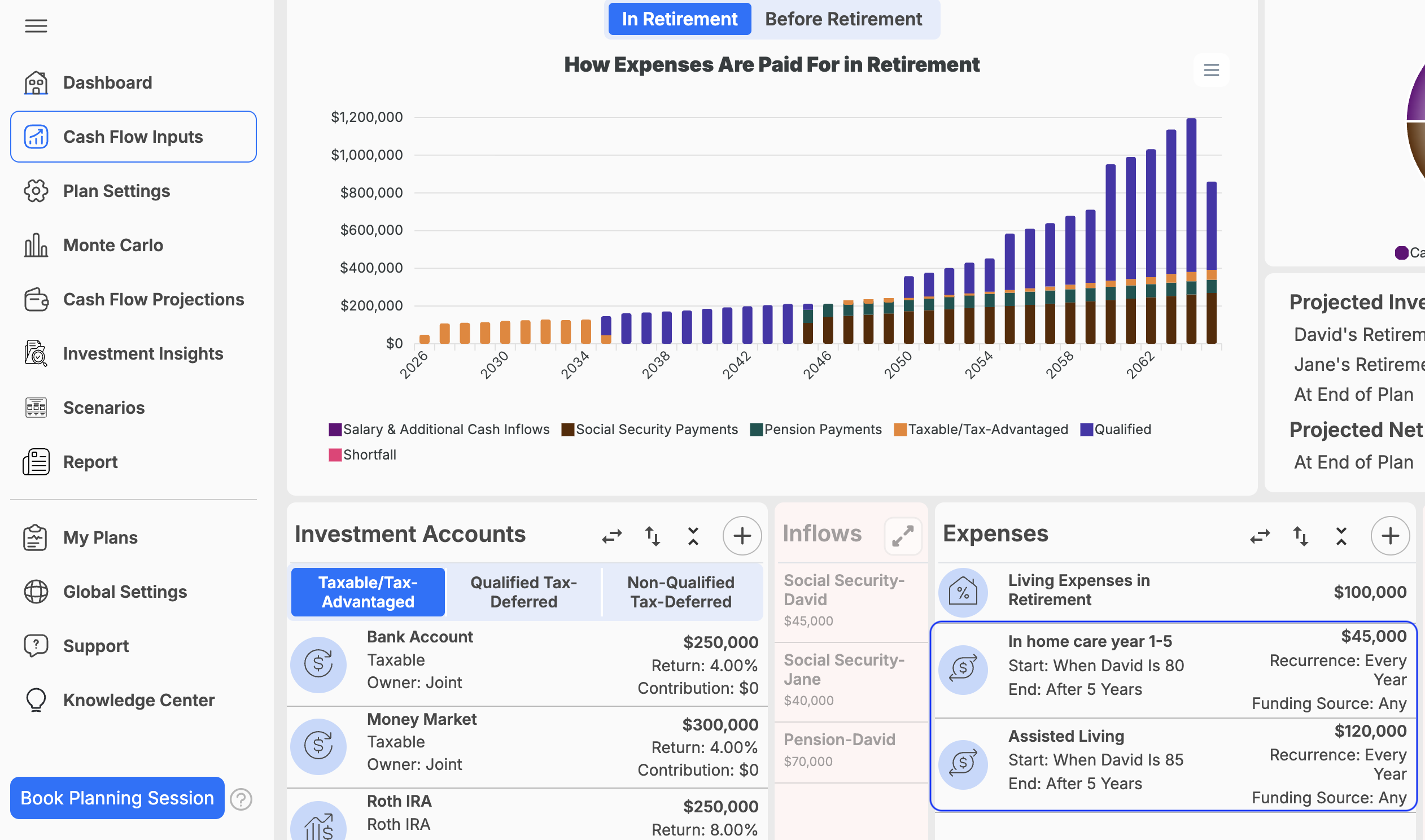
WealthTrace Planning Tip: Model the type of care you would realistically consider rather than automatically assuming the highest-cost option. You can also stress test your plan by comparing different care options and applying different growth rates and durations to each expense.
Medicare Usually Does Not Cover Ongoing Long-Term Care
A common misconception is that Medicare will pay for long-term care. Medicare may cover qualifying short-term skilled nursing or home-health services under certain conditions, but it generally does not cover ongoing custodial care when someone primarily needs help with everyday personal activities.
Most health insurance and Medicare Supplement policies also do not cover extended non-medical care at home, in assisted living, or in a nursing facility. That means long-term care may need to be funded through personal savings, insurance, home equity, Medicaid, or a combination of resources.
From a planning standpoint, ordinary healthcare costs and potential long-term care expenses should usually be entered separately.
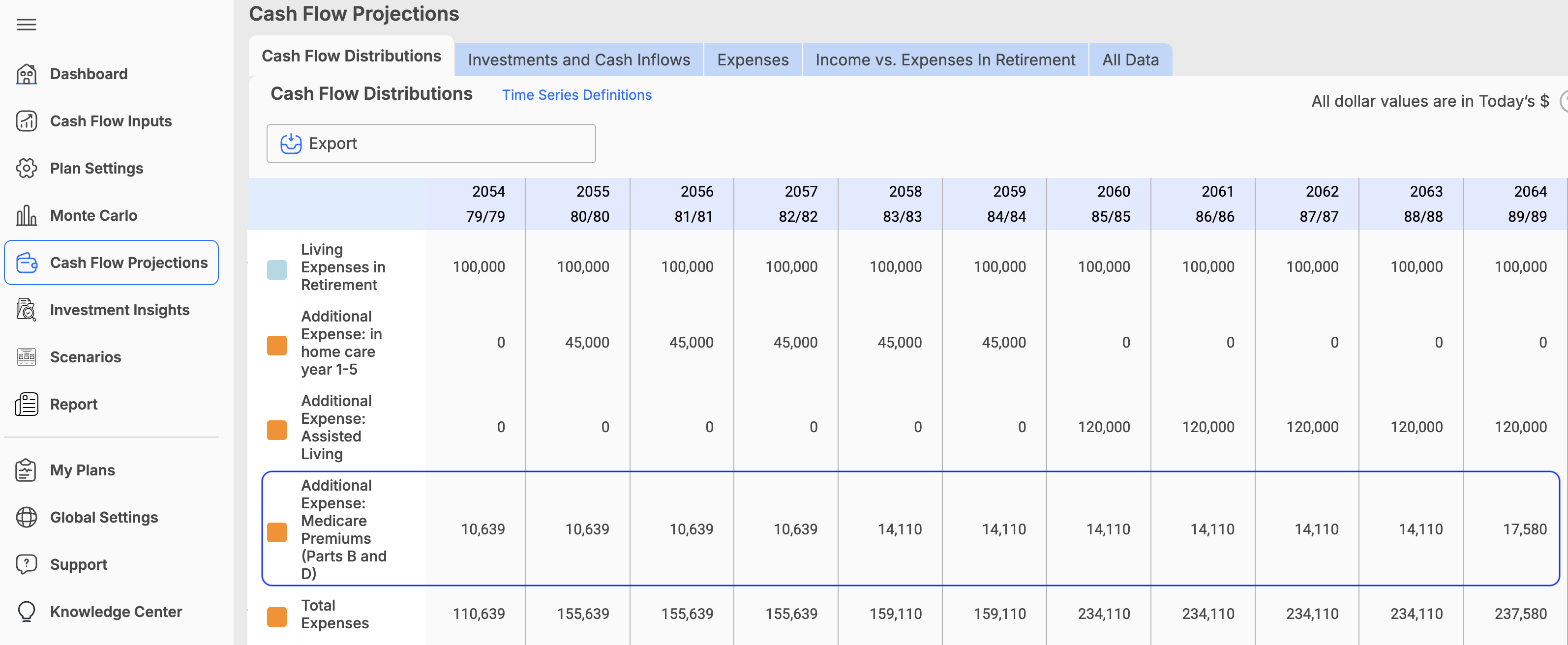
WealthTrace Planning Tip: WealthTrace can estimate your Medicare premiums based on your IRMAA income and automatically add them as an expense in your plan. This helps keep ongoing healthcare costs distinct from potential long-term care expenses.
How Much Could Care Cost?
The cost of care varies by location, setting, and the amount of assistance required.
CareScout’s 2025 national median estimates included approximately:
- $35 per hour for a non-medical caregiver
- $6,200 per month for assisted living
- $114,975 per year for a semi-private nursing-home room
- $129,575 per year for a private nursing-home room
At $35 per hour, 44 hours of home care per week would cost approximately $80,080 per year. These are national estimates, so actual costs may be higher or lower depending on where you live.
The purpose of using an estimate is not to predict the exact bill. It is to determine how much care your plan could reasonably support.
WealthTrace Planning Tip: Research care costs in your area and use those amounts as the starting point for your scenarios.
Build Multiple Care Scenarios
Entering one large care expense may produce an alarming result without providing much useful guidance. A better approach is to compare several possibilities.
A lower-cost scenario could include one or two years of part-time help at home. A moderate scenario might include two or three years of assisted living, while a higher-cost scenario could include several years of memory care or nursing-facility expenses.
Comparing these outcomes can help answer important questions:
- When does the plan begin to feel strained?
- Would discretionary spending need to be reduced?
- Would insurance materially improve the result?
- Could home equity help fund care?
- Would the surviving spouse remain financially secure?
The result does not need to be a simple pass or fail. Your plan may be able to support a moderate care event but require adjustments during a longer or more expensive period.
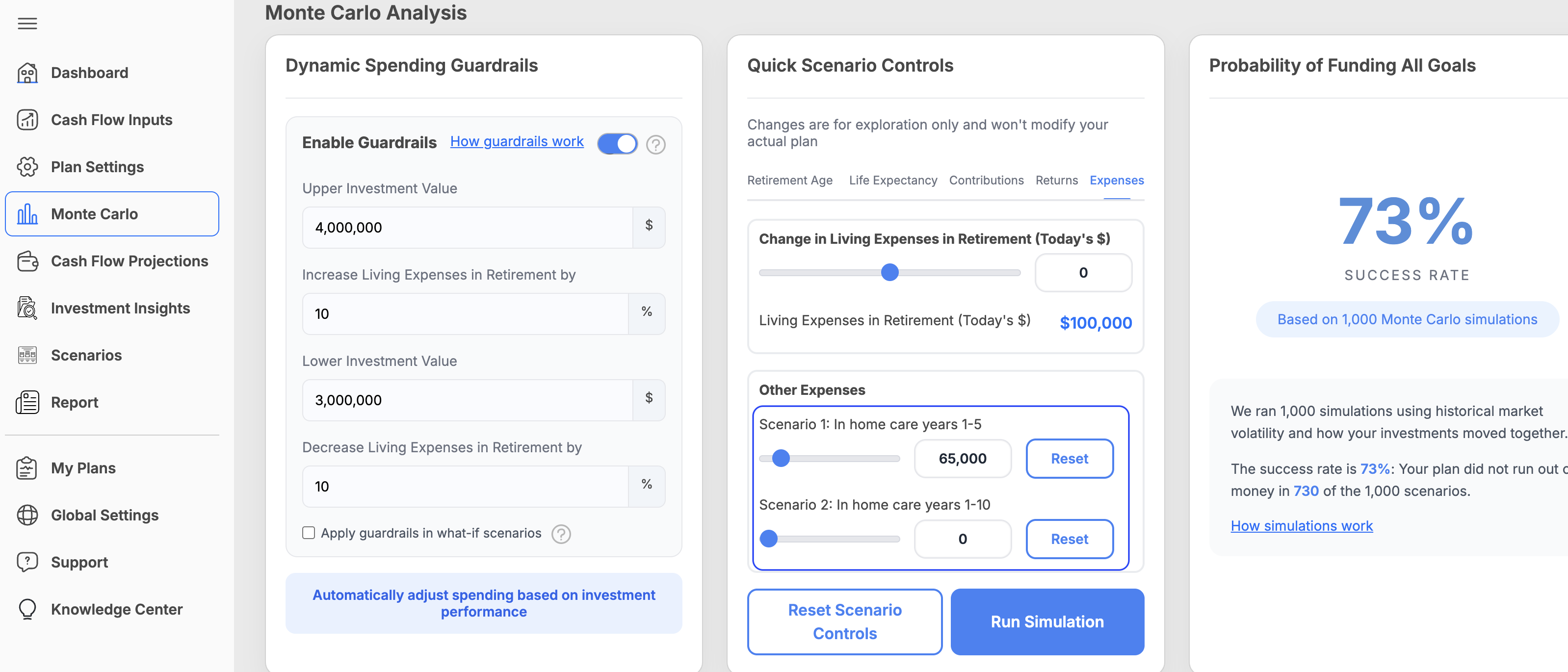
WealthTrace Planning Tip: Compare limited, moderate, and extended care scenarios against the same baseline plan by creating multiple expenses and adjusting their amounts, growth rates, and durations. For larger changes, create separate plans to compare scenarios, or use the Quick Controls in Monte Carlo to see how different care assumptions affect your Monte Carlo score.
Test more than one long-term care outcome.
WealthTrace helps you compare limited, moderate, and extended care scenarios so you can see how each one may affect cash flow, taxes, investments, and Monte Carlo results.
Start Free Trial
Stress-test long-term care costs today.
Account for Rising Care Costs Over Time
Long-term care may not begin until many years after retirement starts. An expense of $75,000 today would grow to approximately $100,800 after 10 years at 3% inflation.
After 20 years, that same expense would grow to about $135,500 at 3% inflation or $164,300 at 4%. Even a small difference in the inflation assumption can have a meaningful effect when care begins later in retirement.
At the same time, automatically choosing a very high inflation rate may overstate the risk. It may be more useful to compare a reasonable base assumption with a higher-cost stress test.
WealthTrace Planning Tip: Individual expenses can be assigned their own growth rates, separate from the plan’s general inflation rate. This allows you to compare a base assumption with a higher long-term care growth rate and see how sensitive your plan is.
Plan for Each Spouse Separately
Married couples should not assume both spouses will need the same care at the same time. One spouse may require assisted living or nursing care while the other continues living at home.
The household may therefore need to support both the care expense and ongoing costs such as property taxes, utilities, insurance, food, and maintenance. The financial impact may also depend on which spouse needs care first.
If one spouse dies, the survivor may lose one Social Security benefit and eventually file taxes as a single taxpayer, which can further affect the retirement plan.
Decide How Care Would Be Funded
Many households use a combination of resources to pay for care. These may include taxable investments, traditional retirement accounts, Roth accounts, insurance benefits, home equity, or Medicaid for those who meet state eligibility requirements.
The funding source matters. Large withdrawals from traditional IRAs or 401(k)s can increase taxable income and may affect Medicare premiums. Selling taxable investments may create capital gains, while qualified Roth withdrawals generally do not increase taxable income.
Insurance benefits can reduce the amount that must be withdrawn from investments, but policy limits, waiting periods, and benefit durations should be reviewed carefully.
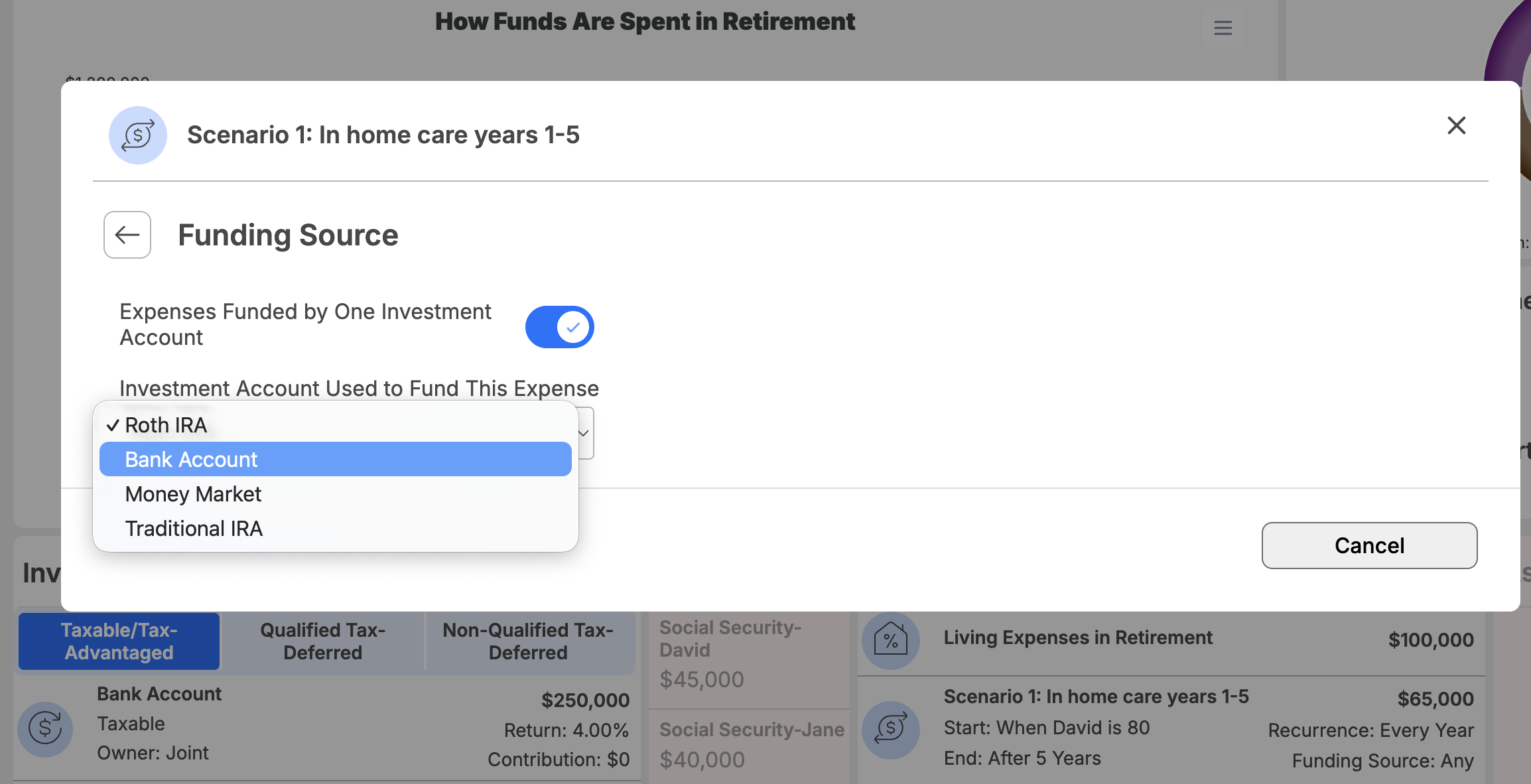
WealthTrace Planning Tip: Enter the full care expense and any expected insurance benefit separately and select the funding source you want WealthTrace to use for each expense. The funding source can have a material effect on taxes, account balances, and your overall retirement outlook.
Look Beyond the Ending Balance
A care scenario will often reduce the portfolio balance, but that does not automatically mean the retirement plan has failed. The more useful questions are whether essential expenses can still be covered, whether the surviving spouse remains financially secure, and what adjustments would be required.
Review cash flow, taxes, Medicare premiums, account withdrawals, Monte Carlo results, housing needs, and the amount remaining for beneficiaries. One family may be comfortable using a meaningful portion of its savings for care, while another may place a higher priority on preserving assets for children, charity, or a family member with special needs.
The Bottom Line
Long-term care is a meaningful retirement risk, but it should not automatically be modeled as an unlimited or catastrophic expense. Some people will never need paid care, while others may need limited help at home or experience an extended and expensive care event.
Instead of trying to predict one exact outcome, test a range of costs, starting ages, durations, inflation rates, and funding sources. This can help you understand how much care your retirement plan could support, where additional preparation may be helpful, and what tradeoffs you would be willing to make if care is eventually needed.