Retirement Planning • Market Risk • Monte Carlo
Managing spending, investments, and withdrawals before the next market decline
Practical steps to protect your retirement savings when markets decline
3 Key Takeaways
1
Early retirement losses are especially damaging. Withdrawing money during a market downturn leaves less invested to benefit from a recovery.
2
Spending flexibility and a balanced portfolio provide protection. Having expenses you can adjust and assets outside of stocks helps reduce pressure on your investments.
3
Stress-testing identifies weaknesses before retirement. Testing different market conditions shows how your plan responds to unfavorable investment returns.
See how your retirement plan could hold up in a market downturn.
Use WealthTrace to test bear markets, spending changes, investment assumptions, and Monte Carlo scenarios before you retire.
Start Free Trial Stress-test your retirement plan. What happens if the market falls right after you retire?
Imagine spending 30 years saving for retirement. You've built a portfolio, decided when to stop working, and calculated how much you can comfortably withdraw each year. Then, six months into retirement, the stock market falls 25%. Your investments have lost value, but your bills haven't disappeared. You still need money for housing, healthcare, groceries, and everyday expenses.
Unlike during your working years, when you’re generally contributing to investments, retirement means regularly withdrawing from your portfolio. Selling investments during a downturn reduces the amount left to participate in a recovery. This is known as sequence of returns risk, and it explains why the timing of market performance matters just as much as average investment returns.
We explored this concept in our previous article, Why Retiring in the Wrong Year Can Change Your Entire Retirement.
Now, let's focus on the steps you can take to prepare for unfavorable market conditions.
1. Build flexibility into your retirement spending
One of the most effective ways to protect your retirement savings is to avoid treating your annual spending as a fixed amount. Let’s say you plan to spend $100,000 annually in retirement. If your portfolio declines 20% during your first year, maintaining the same withdrawal amount puts additional pressure on your remaining investments.
Instead, consider temporarily reducing discretionary expenses by $10,000 or $15,000. Postponing a vacation, delaying a vehicle purchase, or cutting back on entertainment reduces the amount you need to withdraw while investments are down.
Start by separating your retirement budget into two categories:
- Essential expenses: Housing, groceries, utilities, insurance, and healthcare.
- Discretionary expenses: Travel, entertainment, hobbies, and major purchases.
This approach helps you understand how much spending flexibility you have before a downturn occurs. It also allows you to maintain essential expenses without making unnecessary changes to your overall retirement lifestyle.
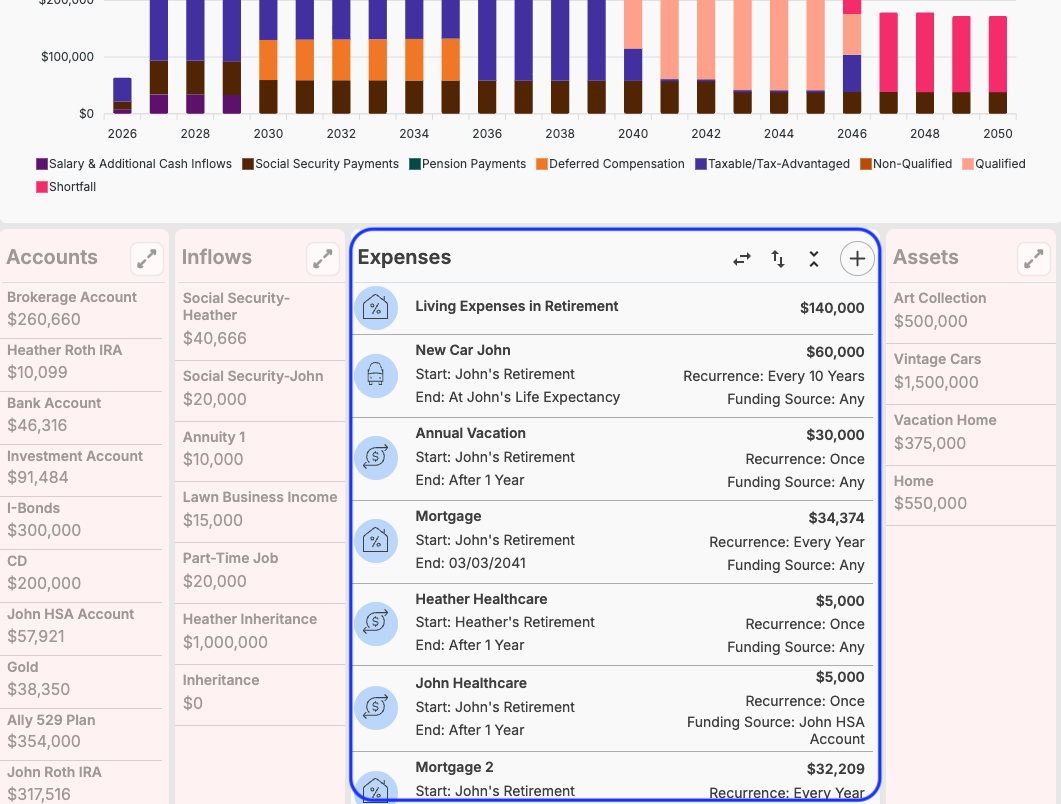
WealthTrace Planning Tip: Use the Budget Worksheet to outline your essential annual living expenses, such as housing, groceries, and utilities. For expenses that don't occur every year, can be adjusted, or grow at a different rate than inflation, create separate entries in the Expenses section. This makes it easier to adjust discretionary spending and see how those changes affect your long-term retirement projections.
2. Balance growth with more stable investments
Stocks remain important in retirement, particularly when your savings need to last 25 or 30 years. However, relying entirely on selling stocks to cover expenses increases your exposure to market downturns.
Consider a retiree who needs $60,000 annually from investments to supplement Social Security and other income. If stocks decline sharply, generating that $60,000 requires selling more shares. Maintaining some cash, short-term bonds, or other lower-volatility investments provides alternative sources of withdrawals during difficult markets.
The goal isn't to move everything into cash or eliminate investment risk. Holding too much cash limits long-term growth and exposes your savings to inflation. Instead, focus on an investment allocation that supports both your immediate income needs and long-term retirement goals.
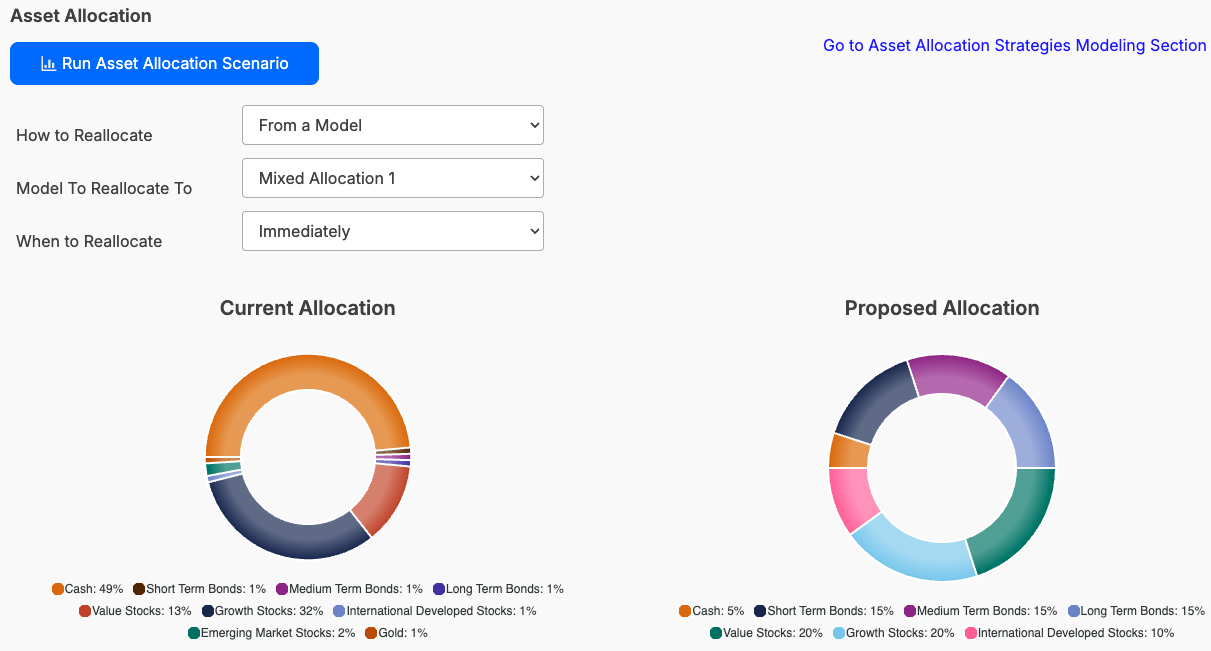
WealthTrace Planning Tip: Experiment with different investment allocations to see how changing the balance between stocks and bonds affects your projected retirement income and portfolio longevity.
3. Stress-test your plan against poor market conditions
Traditional retirement projections often rely on average annual investment returns. But markets rarely follow a predictable path. A portfolio averaging 6% over 20 years doesn't earn 6% every year, and experiencing several negative years immediately after retirement creates a very different outcome than experiencing those losses later.
Monte Carlo analysis addresses this uncertainty by simulating many possible investment return sequences. Instead of relying on one projected outcome, it estimates how frequently your retirement plan successfully funds your expenses under different market conditions.
Beyond Monte Carlo analysis, consider testing specific scenarios:
- A 25% market decline during your first year of retirement
- Several consecutive years of below-average returns
- Higher inflation combined with increased living expenses
- Temporarily reducing discretionary spending
- Delaying retirement by one or two years
Comparing these scenarios reveals which assumptions have the greatest impact on your financial outlook and which adjustments improve your results.
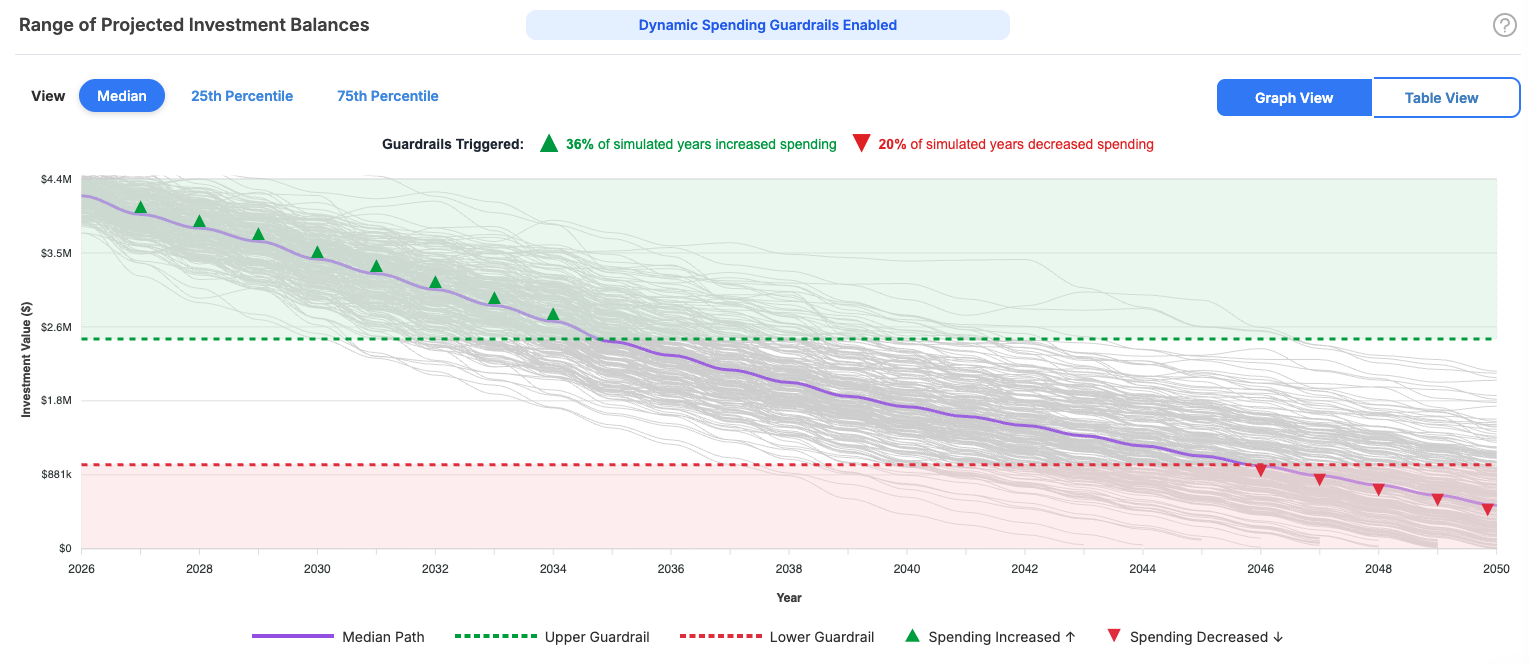
WealthTrace Planning Tip: WealthTrace runs 1,000 Monte Carlo simulations to evaluate retirement outcomes under different market conditions. You can also test bear market scenarios and use Dynamic Spending Guardrails to simulate increasing spending when markets perform well and reducing spending during downturns. This helps you evaluate how flexible withdrawals affect the long-term sustainability of your retirement plan.
4. Establish a plan before you need it
The middle of a market downturn is not the ideal time to make major financial decisions. Before retiring, determine how you'll respond to a significant portfolio decline. Identify which expenses you would reduce, how you'd manage withdrawals, and what conditions would prompt you to review your investment strategy.
Review these decisions as retirement approaches and continue revisiting your plan annually. Changes in spending, investment performance, healthcare costs, and Social Security income all affect your financial outlook. Keeping your projections current ensures your decisions reflect your actual circumstances rather than assumptions made years earlier.
Test your plan before the next market downturn.
WealthTrace helps you compare bear markets, spending strategies, investment allocations, and Monte Carlo results under different market conditions.
Start Free Trial See where your plan is vulnerable. The Bottom Line
Preparing for a market downturn isn't about predicting when stocks will fall. It's about building a retirement plan that remains flexible when investment performance doesn't meet expectations.
Before retiring, ask yourself: What would happen to my retirement plan if the market fell 25% during my first year? Understanding the impact now gives you an opportunity to make adjustments before your retirement income depends on those investments.
With WealthTrace, you can test bear markets, compare spending strategies, adjust investment assumptions, and run Monte Carlo simulations to evaluate your retirement plan under different market conditions.