Retirement Planning • Saving • Monte Carlo
Your plan could be overfunded
How to tell when your retirement plan gives you room to spend, give, retire earlier, or enjoy more flexibility
3 Key Takeaways
1
A retirement plan can be funded well beyond the amount needed to support your desired lifestyle.
2
Saving more is not always the best use of an additional dollar if your plan already has a substantial margin for error.
3
Testing higher spending, earlier retirement, gifts, travel, or other goals can help reveal how much flexibility you actually have.
Want to see how much flexibility your retirement plan gives you?
Use WealthTrace to test higher spending, earlier retirement, gifts, travel, charitable giving, and other goals against your retirement plan.
Start Free Trial
Test retirement tradeoffs in minutes.
Saving more for retirement is usually treated as an unquestioned good. For many households, it is. But once you have built a strong retirement plan, continuing to save aggressively can sometimes come at the expense of goals you could afford to enjoy today.
That does not mean you should stop saving simply because your projections look good. It means your retirement plan should help answer a broader question: Are you balancing your money appropriately between your future and your life today?

A Strong Retirement Plan Is Supposed to Give You Options
Most retirement planning starts with the risk of not saving enough, and for good reason. Running short of money later in life has serious consequences. But some households eventually reach a point where the bigger question is no longer whether they have enough. After decades of focusing on accumulation, they may have more financial flexibility than they realize.
If your plan remains strong even under conservative assumptions, the question can shift from “Do I have enough?” to “What else can I afford to do?” That could mean retiring earlier, traveling more, helping children or grandchildren, making charitable gifts, purchasing a second home, or simply spending a little more without feeling guilty about it.
The goal is not to finish retirement with the largest portfolio possible. It is to use your money for the things that matter to you while still maintaining enough of a cushion for the future.
A Large Ending Balance Does Not Automatically Mean You Saved Too Much
A large projected ending balance can make it look like you have saved far more than necessary, but retirement planning is not that simple. Your portfolio still needs to withstand decades of uncertain investment returns, inflation, healthcare costs, taxes, changes in spending, and the possibility of living longer than expected. Maintaining a cushion can be especially important if your expenses are difficult to reduce or leaving money to heirs is a major goal.
The better question is whether your plan has more margin than you actually need based on your goals and risk tolerance. Imagine a household planning to retire at 65 and spend $90,000 per year. Even after testing weaker market returns and higher spending, their plan still shows a strong outcome and a substantial ending balance. That does not mean they should dramatically increase spending, but it does give them room to test other choices.
Perhaps retiring at 63 still produces an acceptable result. Maybe adding $10,000 per year of travel during the first decade of retirement has only a modest effect on the plan. Or perhaps they could give money to family earlier in life rather than leaving the entire amount as an inheritance decades from now. The point is not that they should make any one of these choices, but that a strong plan gives them the ability to compare them.
Think in Terms of Tradeoffs, Not Targets
Retirement planning often gets reduced to a single savings target: accumulate a certain multiple of your salary, contribute a specific percentage each year, or reach a particular portfolio value. Those rules can be useful starting points, but they do not reflect the details of your actual retirement. Two people with identical portfolios could have very different financial situations depending on their Social Security benefits, pensions, taxes, spending, retirement ages, investment allocations, and other assumptions.
Instead of focusing on whether you have crossed an arbitrary savings threshold, look at the decisions that are actually available to you. You could test retiring one or two years earlier, increasing retirement spending, setting aside more for travel, helping children with a home purchase, funding education for grandchildren, making larger charitable gifts, reducing current retirement contributions, or increasing the amount you hope to leave to heirs. You do not need to choose any of these simply because the plan says they are possible. But you should know what the tradeoffs look like.
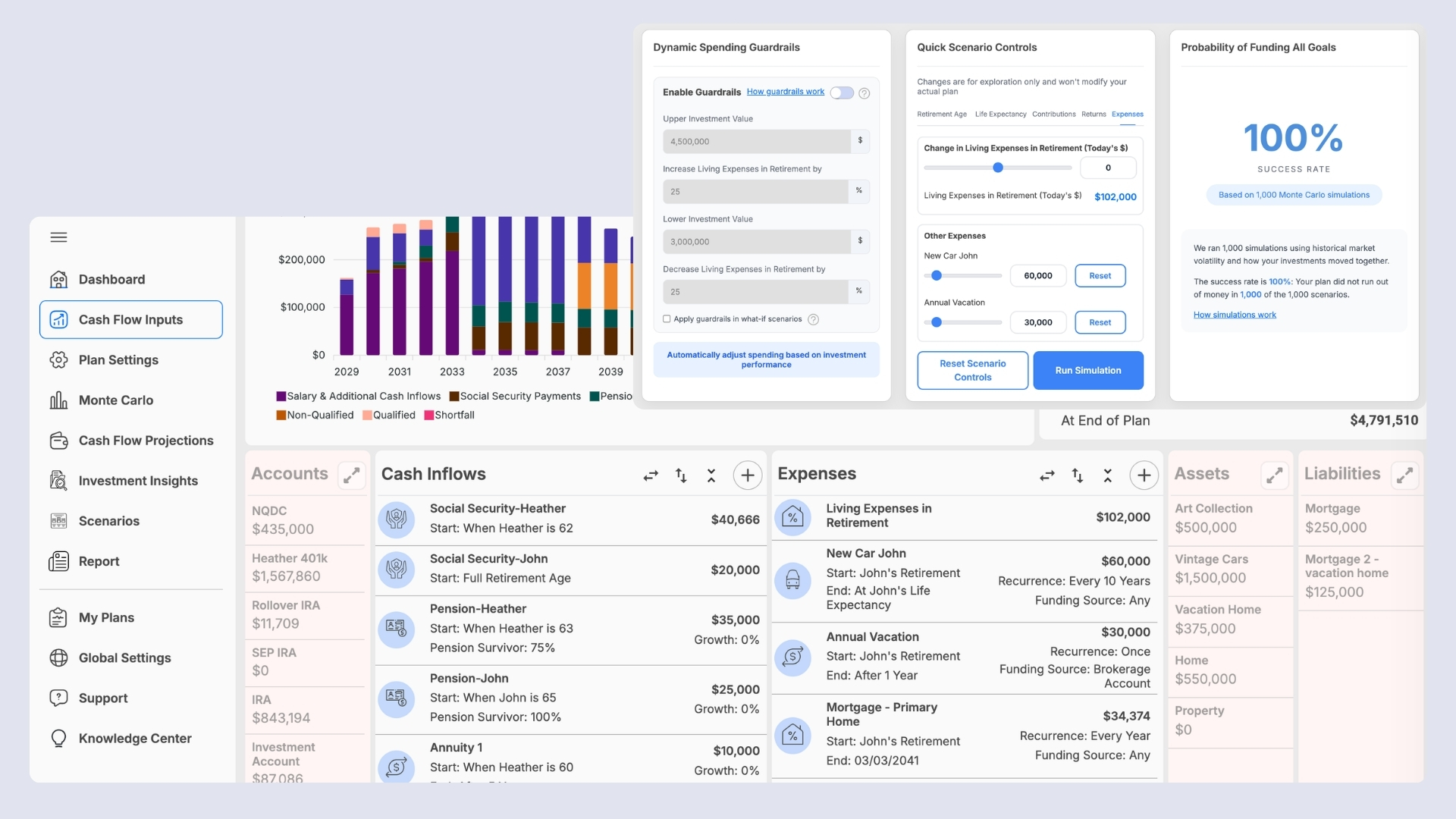
WealthTrace Planning Tip: You can test many of these tradeoffs directly on the Monte Carlo screen. Use Quick Scenarios to adjust living expenses, existing additional expenses, retirement age, age of death, annual returns, or contributions. Dynamic Spending Guardrails can also model a more realistic retirement spending pattern, where you spend more when markets perform well and cut back when they do not.
For larger changes, adjust your plan inputs to model a major purchase, asset sale, new expense, or other significant change. Then compare the effect on your Success Probability and long-term balances.
If you want to see how WealthTrace brings these planning tools together, take a look at our How WealthTrace Works page.
Your Success Probability Can Help Measure the Tradeoff
A very high Success Probability does not automatically mean you should spend more, just as a lower number does not automatically mean your plan is unacceptable. The more useful information often comes from how much the result changes when you test a specific decision.
Suppose your current retirement plan has a 94% Success Probability. You add $8,000 per year of travel spending during the first ten years of retirement and the result falls to 91%. The additional spending has an impact, but a three-percentage-point change might be a tradeoff you are comfortable making. Now suppose retiring three years earlier drops the result from 94% to 68%. That creates a much larger financial tradeoff and deserves a closer look.
Comparing scenarios this way helps you understand the cost of each decision rather than simply trying to achieve the highest possible probability of success. A strong plan does not need to be optimized for the largest ending balance or the highest Monte Carlo result. It needs to support the goals that matter most to you at a level of risk you are comfortable with.
Compare the retirement choices that matter most to you.
WealthTrace lets you test spending, retirement age, gifts, travel, investment returns, guardrails, and legacy goals in one retirement plan.
Start Free Trial
See your plan's flexibility.
Do Not Let Caution Become the Default Plan
Keeping a healthy cushion is reasonable, especially if you are concerned about long-term care, unexpected expenses, family needs, or difficult markets. But there is a point where being overly cautious can keep you from doing things your plan clearly supports.
Saving for retirement requires decades of putting money aside for later. A strong plan should eventually help you decide when it is reasonable to use more of that money, whether that means retiring sooner, spending more, traveling while you are healthy, or helping family while you are still here to see the benefit. Those decisions should still be grounded in careful planning, but the goal should not be to preserve every possible dollar simply because you can.
The Bottom Line
It is possible to save more for retirement than you ultimately need, but that does not mean excess savings should automatically become extra spending. A better approach is to test the choices you genuinely care about and see what they do to the plan.
If your retirement plan remains strong across a range of assumptions, try modeling an earlier retirement, more travel, gifts to family, charitable giving, or a higher standard of living. A strong retirement plan should do more than tell you that you are unlikely to run out of money. It should help you understand how much freedom that financial security gives you.
Interested in exploring more retirement planning strategies? Visit the WealthTrace Blog for more articles on retirement income, taxes, Social Security, Roth conversions, Monte Carlo analysis, and other planning topics.