Retirement Planning • Survivor Planning • Taxes
How the Widow's Penalty Can Affect Retirement
The Impact of Losing a Spouse on Income, Taxes, Medicare Costs, and Long-Term Financial Security
3 Key Takeaways
1
A surviving spouse could have less household income while still facing many of the same expenses.
2
The shift from married filing jointly to single can result in higher taxes and Medicare premiums, even when household income declines.
3
A retirement plan should model both spouses' lifetimes separately, so the surviving spouse's long-term finances are not overlooked.
Want to see how survivor planning could affect your retirement?
Use WealthTrace to model both spouses' life expectancies, Social Security benefits, tax projections, Medicare premiums, expenses, and account withdrawals so you can better understand how a surviving spouse can be affected.
Start Free Trial
Test survivor income and tax scenarios.
Retirement plans for retired couples are often built around a shared financial life, including two Social Security benefits, married-filing-jointly tax brackets, and expenses planned for one household. When one spouse dies, income might decline while many expenses and taxable withdrawals continue.
This combination is often called the widow's penalty. It is not a separate tax, but rather the financial disadvantage that can occur when a surviving spouse has less income while facing less favorable tax and Medicare rules.

Social Security Income Can Decline
Many retired couples receive two Social Security payments each month. After one spouse dies, the surviving spouse generally cannot continue collecting both benefits in full.
Depending on age and eligibility, the survivor might be able to receive a benefit based on the deceased spouse's record. Survivor benefits can begin as early as age 60, although claiming before survivor full retirement age generally reduces the monthly amount. At survivor full retirement age, an eligible survivor can receive up to 100% of the deceased spouse's benefit.
Consider a couple receiving monthly Social Security benefits of $3,200 and $2,000. Together, they receive $5,200 per month. After one spouse dies, the survivor can receive the larger $3,200 benefit, but the household still loses $2,000 per month, or $24,000 per year.
Household income can therefore fall substantially even though many expenses remain.
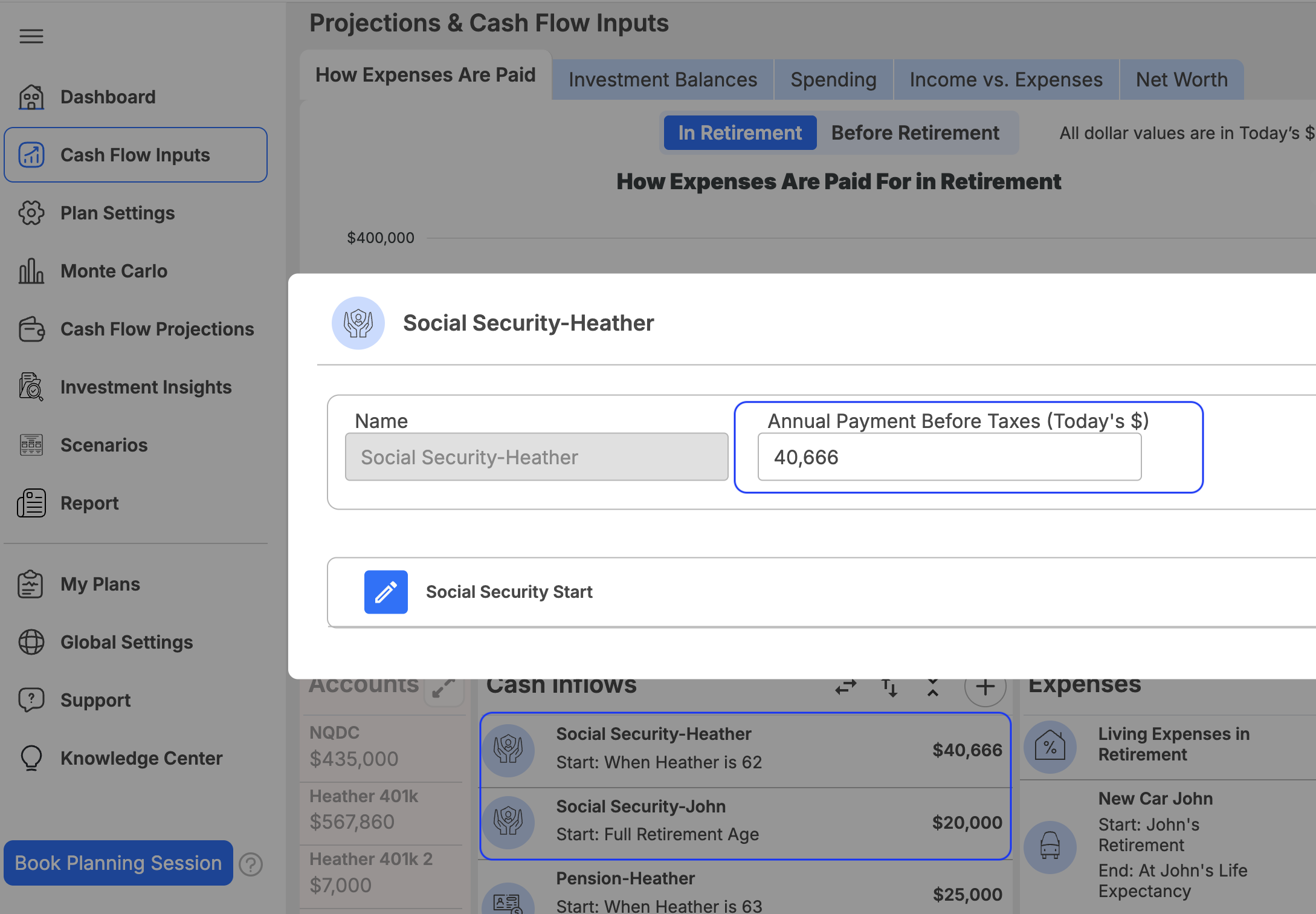
WealthTrace Planning Tip: Review each spouse's projected Social Security benefit and life expectancy separately to see how much income will remain after the first death. By default, WealthTrace assumes the surviving spouse can receive the other spouse's benefit if it is higher. You can change this assumption in the Social Security section.
Expenses Usually Do Not Fall by Half
Although some costs decline after a spouse dies, many major expenses remain similar, including property taxes, homeowners insurance, utilities, home maintenance, and vehicle costs. The survivor might also need to pay for services previously handled by the other spouse.
For example, cutting a couple's $90,000 annual spending estimate to $45,000 could understate the survivor's needs. A more realistic amount might be $65,000 or $70,000, depending on the household. The key point is that income might fall much faster than expenses.
WealthTrace Planning Tip: WealthTrace automatically assumes living expenses will decrease by 25% after the first spouse dies. You can adjust this percentage in the Living Expenses in Retirement entry under Expenses or use varying expenses to model more specific spending changes over time.
The Surviving Spouse Will Likely Face Higher Tax Rates
The change in filing status might not happen immediately. In the year a spouse dies, the surviving spouse can generally still file a joint federal tax return if the requirements are met. A survivor with a qualifying dependent child might also be eligible to use qualifying surviving spouse status for the next two years.
Many retired survivors, however, do not have a dependent child and will generally file as single beginning in the year after their spouse's death. Single taxpayers have narrower tax brackets and a lower standard deduction than married couples filing jointly. Meanwhile, taxable income from required minimum distributions, pensions, investment income, and retirement account withdrawals might continue.
For example, imagine that a couple has $140,000 of taxable retirement income while filing jointly. After one spouse dies, income falls to $105,000. Although household income is $35,000 lower, the survivor could still face a higher effective tax rate because the income is now reported on a single return.
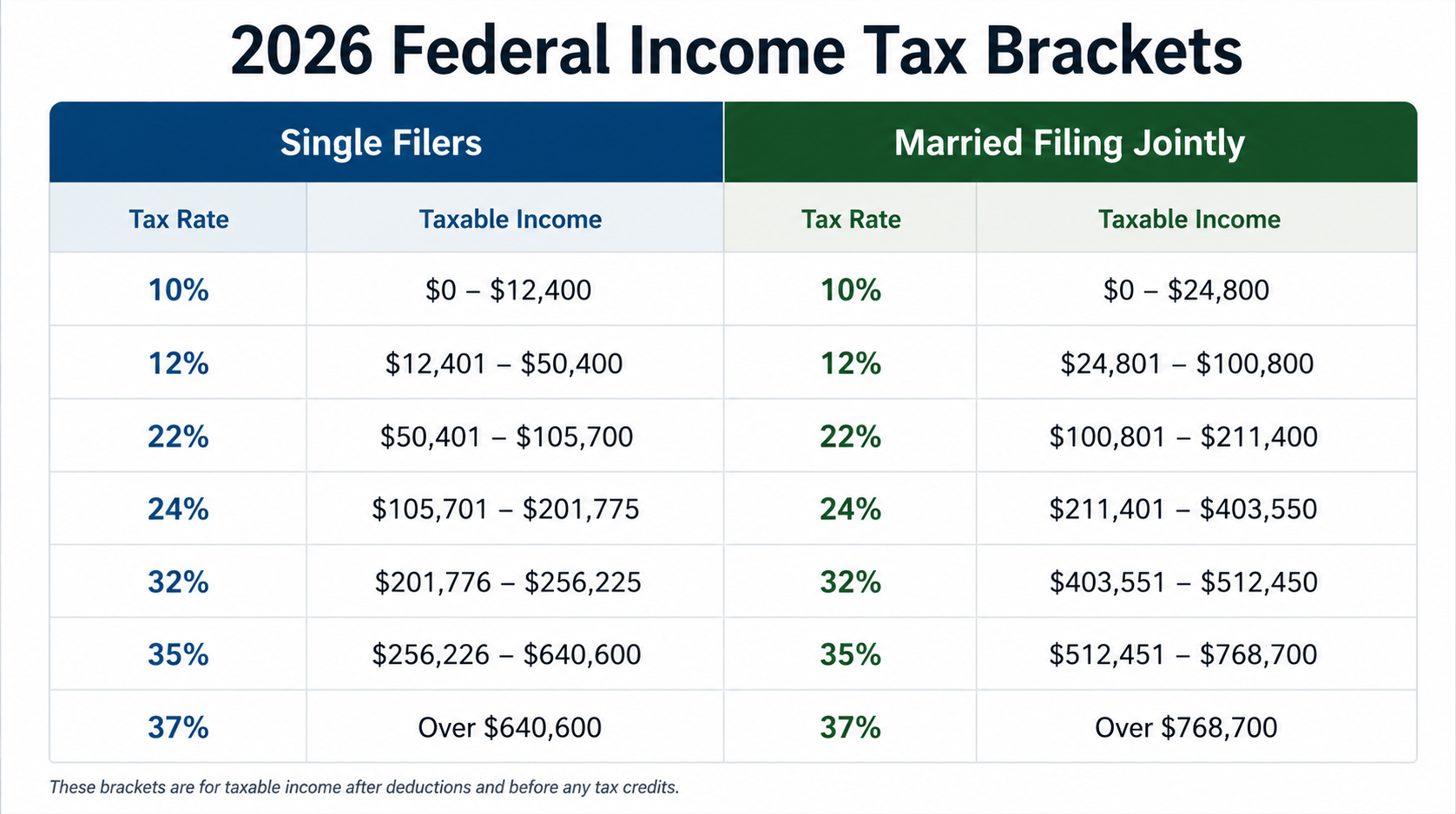
This is one of the more difficult parts of the widow's penalty: household income declines, but a larger percentage of it will go toward taxes.
WealthTrace Planning Tip: Model the first death at different ages and review the survivor's projected taxable income, especially in years with large required minimum distributions or other taxable withdrawals. You can adjust each person's life expectancy in Plan Settings → Personal Information.
Medicare Premiums Can Also Increase
The surviving spouse can also face higher Medicare premiums. Medicare's income-related monthly adjustment amount, or IRMAA, increases Part B and Part D costs when modified adjusted gross income exceeds certain thresholds. The calculation is generally based on income reported two years earlier.
For 2026, the first IRMAA threshold is income above $218,000 for married couples filing jointly and $109,000 for individual filers. Because the survivor's income might not fall by half, a household that remained below the joint threshold could exceed the individual threshold after the first death.
Suppose a married couple has modified adjusted gross income of $180,000. That amount is below the 2026 joint threshold. After one spouse dies, the survivor's income falls to $125,000. Although household income is lower, it is now above the individual threshold, which could cause the survivor to pay a higher Medicare premium.
The death of a spouse is considered a life-changing event for Social Security purposes. If household income also declines, the survivor can request that Social Security use more recent income information when determining IRMAA. However, lower individual thresholds can still result in higher premiums.
See how taxes and Medicare costs could change for a surviving spouse.
WealthTrace can help you model Social Security income, filing status changes, IRMAA thresholds, RMDs, Roth conversions, and taxable withdrawals under different survivor scenarios.
Start Free Trial
Model survivor scenarios in minutes.
Large Pre-Tax Balances Can Magnify the Penalty
Traditional IRAs and employer retirement accounts can create another challenge. After the first death, the surviving spouse will likely hold most of the couple's remaining pre-tax retirement assets while filing a single tax return and facing lower Medicare income thresholds. Future withdrawals and required minimum distributions can therefore create a larger tax burden than expected.
Some couples consider Roth conversions while both spouses are alive and filing jointly to reduce future taxable balances. However, conversions can also increase current taxes and Medicare premiums, so the strategy should be evaluated as part of the full retirement plan.
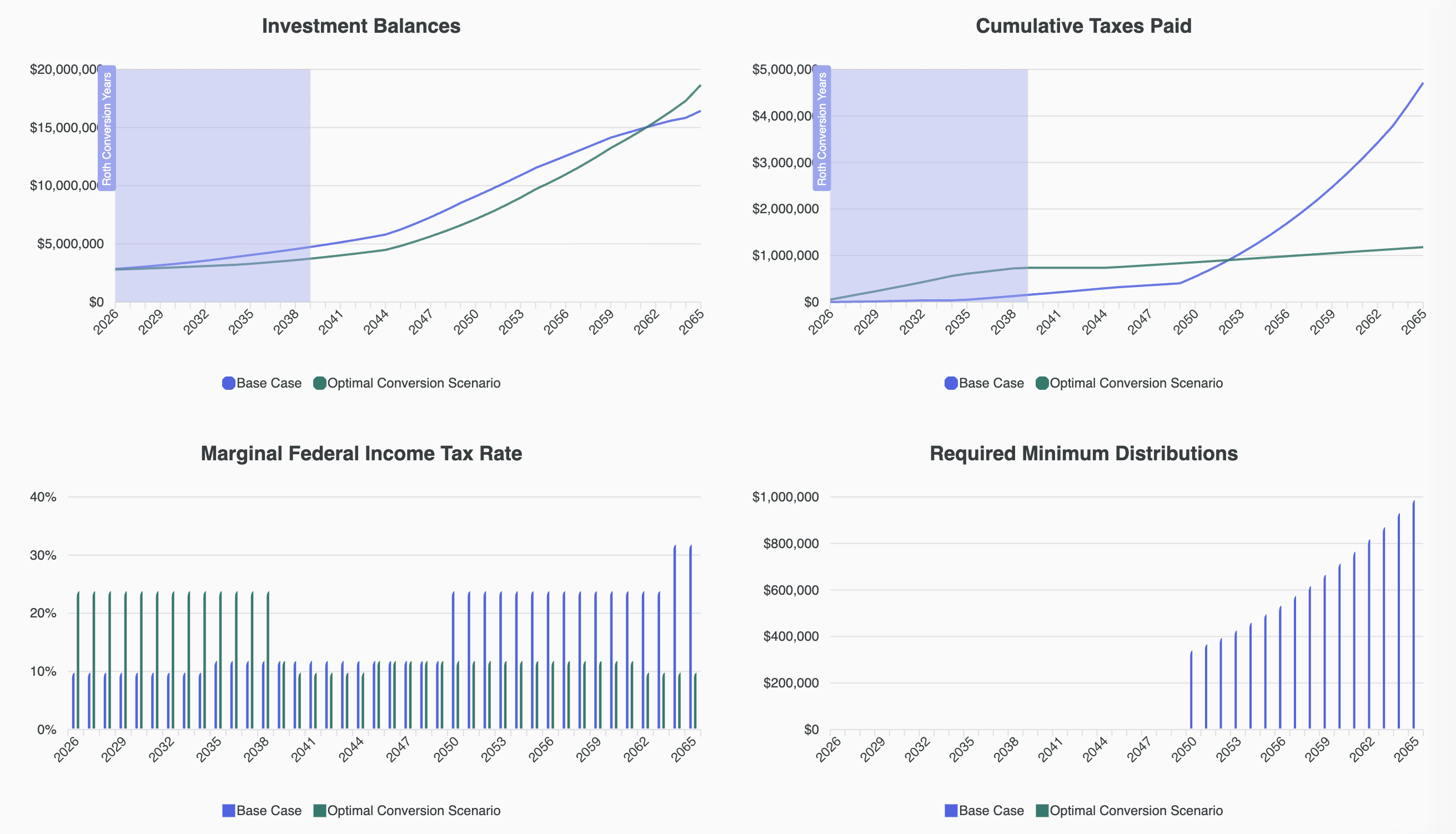
WealthTrace Planning Tip: Run multiple Roth conversion scenarios to compare how different conversion amounts will affect lifetime taxes, Medicare premiums, and the surviving spouse's portfolio. The Roth Conversion Optimizer can also calculate an optimal conversion strategy based on the information in the plan.
The Bottom Line
After the death of a spouse, household income might fall more quickly than expenses. At the same time, the surviving spouse will likely face less favorable tax brackets, lower Medicare income thresholds, and continued taxable withdrawals from pre-tax accounts.
A complete retirement plan should model what happens after the first death and test different life expectancies. The goal is not to predict exactly what will happen, but to make sure either spouse could remain financially secure on their own while managing Social Security, taxes, Medicare premiums, taxable withdrawals, and long-term retirement income.