What Exxon Can Do For Your Retirement Portfolio
Key Takeaways
Dividend growth can make a significant difference to retirement savings, even when stock-price growth is modest.
Companies with a long history of maintaining and increasing dividends through recessions may provide more dependable income over time.
Diversifying across several strong dividend-paying companies can improve retirement outcomes rather than relying on a single stock.
When I look to add dividend paying stocks to my retirement portfolio I always look for companies that have a long history of paying dividends as well as a history of solid growth in those dividends. It's even better if the company has shown it can weather recessions by not cutting its dividend when the economy goes south.
One of my favorite stocks that fits this bill is Exxon (XOM). Exxon has averaged nearly 10% growth in its dividend over the past 5 years. The average annual growth rate over the past 10 years has been right around 10% as well. During the recession in 2008/2009, Exxon actually increased its dividend by 20%, which is amazing given that it is considered a cyclical company that moves with general economic conditions.
This article is not going to recommend that people invest heavily in stock funds or ETFs for the rest of their lives. This strategy has gotten too many people into way too much trouble over the past 15 years. What I want to discuss today is how carefully selecting and investing in dividend paying stocks that will have solid dividend growth for the next 20 years, such as Exxon, can pay off big time in the long-run and reduce stress immensely as movements in the stock price eventually barely matter.
Although I will focus on Exxon in this discussion, the strategy here applies to many companies that have a solid history of increasing (or at least not cutting) their dividends over time, even during recessions. Other companies that fit this mold are Johnson & Johnson (JNJ), Coca-Cola (KO), Intel (INTC), 3M (MMM), Chevron (CVX), Procter & Gamble (PG), and Wal-Mart (WMT).
What I want to show today is how a dividend paying stock like Exxon can change a person’s entire retirement situation. I want to take a look at a 45 year old couple that has been scared out of the stock market and currently has everything invested in long-term treasury bonds at 2.9%. They currently have $400,000 saved. Let’s also apply an inflation rate of 2% for each year. They plan on retiring when they are 65. How much money can they expect to have when they retire if we take into account inflation? For this example I assumed half of their money was in a qualified, non-taxable account such as an IRA. They pay taxes at a 30% rate on their investment income and dividends are taxed at a 15% rate.
Here are the results for this couple if they keep all of their money invested in low-yielding treasuries:
In 20 years their investments have only grown by a mere $55,890 if we reduce everything by the inflation rate. That is only 0.60% per year in real terms. I plugged in these numbers into our Retirement Planner and found that this couple would only have a 17% chance of not running out of money if they save $10,000 a year for the next 20 years, spend $45,000 a year in retirement and receive $35,000 a year in social security payments. This couple is headed for serious trouble.
Now let’s look at the case where they invest in a basket of solid dividend payers such as Exxon. It is important to note that I am not recommending investing in just one stock. I am recommending investing in a basket of solid dividend paying stocks that have characteristics similar to Exxon.
In this example I assumed a dividend yield of 2.7% (Exxon's current dividend yield), long-term annual dividend growth of 9%, and no increase in the stock price at all. I ran these numbers in our free online calculator called Dividend Yield And Growth.
Now we’re talking some real money when they retire. They will have nearly $800,000 (in today’s dollar terms) when they retire. Plugging these numbers into our Retirement Planner I found that they now have an 80% chance of never running out of money in retirement. It is important to keep in mind that I assumed no change in the stock price in this example. I wanted to show how just collecting the dividends from strong dividend growth stocks can have such a large impact. If we assume the price of the stock increases by just 2% per year over this time frame the ending real value of the account is over $1.1 million and the probability of never running out of money in retirement jumps up to over 90%.
Because of the time factor involved with dividend growth stocks it is of utmost importance to begin investing wisely when you’re relatively young. For those who are already in their 60s this strategy will not be as useful, although it can still be a significant part of their overall strategy.
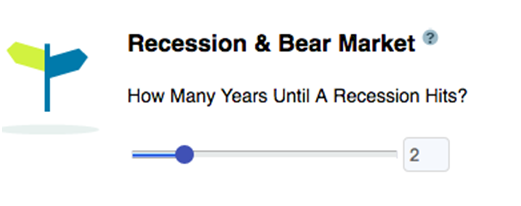
WealthTrace can run your portfolio through a bear market and show you how it could affect your retirement plans. Learn more.
In a short period of time, let’s say the portfolio loses 30% of its value. Living expenses, meanwhile, definitely do not go down by 30% over the same period. That initial 2% drawdown rate now jumps to more like 3% at exactly the wrong time. They’ll be pulling out money faster and faster just as the market has taken a big bite out of the account.
Pension To The Rescue
It can be a different story, however, if one or both of the plan participants have a pension.
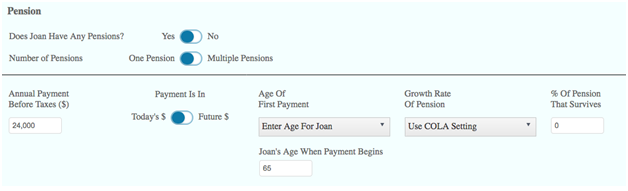
Pensions are less common than they used to be, but can make a big difference during the lean years of a retirement plan.
In this example, one person in the couple is projected to have $24,000 coming in via a pension--about what the couple would need to cover that 2% portfolio drawdown. Instead of pulling out portfolio principal when the market corrects, they can rely on the income from the pension.
Things To Consider With A Pension
WealthTrace can help you drill down into a retirement plan that accounts for pension income. You’ll want to know a few things before you get started inputting the information:
When does the payout start? Similar to Social Security, you might have some say about this (and the sooner you start to take the payments, the less it will be each year).
How much will the payout be to start with? See previous item--one likely depends on the other.
At what rate will the pension benefit grow (if it grows at all)? Sometimes pensions are indexed to inflation, sometimes not.
How much, if any, of the pension will continue to be paid out to the surviving spouse? Most likely, at least some portion of it will be paid out--the survivor’s benefit--in the event that the pensioner dies before his or her spouse does.
Is there a chance the pension will be reduced, or even disappear? This is a tricky one, and painful to contemplate. But industry landscapes change; pension funding projections can be too optimistic; the future is unknowable. It might make sense to trim back projected pension benefits a bit just to be conservative when putting your plan together.
Most retirees will take cash flows any way they can get them, but pensions are among the best ways. Count yourself fortunate if you have one--and make sure to account for it properly when putting your retirement plan together.
There is a lot more to a successful retirement plan than just hitting a number. You’ll want to WealthTrace covers all the bases. Learn more.
Explore the potential of a 2.7% yield
Use WealthTrace to adjust dividend-growth assumptions and project future income.