$1 Million Is Not What It Used To Be
Key Takeaways
A $1 million retirement portfolio may not provide the security it once did, especially when inflation and low interest rates reduce purchasing power.
For the example couple, $1 million provided only a 55% probability of never running out of money, while $1.7 million was needed to reach an 85% success probability.
Using lower-volatility dividend-growth stocks, combined with modest spending cuts or delaying retirement, can improve the chances of making retirement savings last.
Many of us remember the days when being a millionaire meant you had made the big time. The same was true when retiring with $1 million in the bank. But compounding inflation and low interest rates have turned that idea on its head.
I spend a lot of time helping people understand how much money they will need to meet their retirement goals. In this article I want to look at how much a typical couple will need to retire comfortably when they are 65 years old. I will then look at ways they can improve their chances of never running of money by buying dividend-growth stocks with a long history of dividend growth.
Like any retirement calculations, this one involves many assumptions. But as long as our assumptions are reasonable, say 6% for equity returns rather than the 10% figure that many people used to use, we can come up with a very reasonable estimate for how much money one needs to retire comfortably.
Let’s start with the assumptions I used for the couple we will look at:
Before generating a retirement plan for this couple the first thing we need to clear up is, what constitutes success? We live in a dynamic world, especially when it comes to investing. So I like to look at the probability of never running out of money in retirement using Monte Carlo analysis, where thousands of scenarios are run, shocking investment returns in every scenario in every year. In this example I will define success as having a probability of at least 85% that funds never run out in retirement.
Using Monte Carlo analysis in our retirement planner I calculated that the probability they never run out of money is only 55%. So much for the notion that $1 million in retirement means comfort and relaxation.
One question we can ask here is, how much do they really need at retirement such that their odds of success are at least 85%? I ran this analysis and found that they need $1.7 million when they retire in order to have an 85% of plan success.
Of course, adding another $700,000 to the retirement portfolio is easier said than done. They can of course retire at a later date, but let's put that idea on the shelf before we look at another option.
Another question we can ask is, how can change their investment strategy to increase the odds of retirement plan success? There are really only two ways to do this since this couple is already retired (assuming they don’t want to go back to work): They can find higher returning investments with the same level of volatility they currently have or they can find investments that have the same returns, but less volatility.
My favorite way to reduce volatility while maintaining reasonable levels of return is to buy high quality dividend paying stocks that have a history of rising dividends over time. A few of my favorite dividend payers for retirement portfolios that have consistently raised their dividends over the years are Johnson & Johnson (JNJ), Sysco (SYY), AT&T (T), Wal-Mart (WMT), Coca-Cola (KO), and Eli Lilly (LLY).
I replaced their Equity Value fund with the stocks listed above, equally weighted. I kept the same total return assumption, but lowered the level of volatility to the historical levels of these stocks. That is, I reduced the volatility level from about 16% to 13% per year.
The probability that this couple never runs out of money now jumps from 55% to 65%. This is a large jump, solely due to the fact that they are now invested in more stable, solid dividend paying stocks instead of an equity index fund.
They are not yet at our 85% threshold, but it is a good start. The idea of moving into stable dividend-growth stocks combined with cutting their spending by a small amount and possibly retiring a year or two later can get them to where they want to be. In fact, I found that if they use the dividend-growth portfolio, cut their spending by 2%, and retire one year later, they will indeed have an 85% chance of never running out of money.
Each person and couple has a different situation and might need to change a variety of things in order to meet their retirement goals. But it is usually impossible to tell whether or not you can retire when you want until you sit down and actually run through the numbers. At that point you can begin running interesting scenarios that will tell you what you need to do to get to your goals.
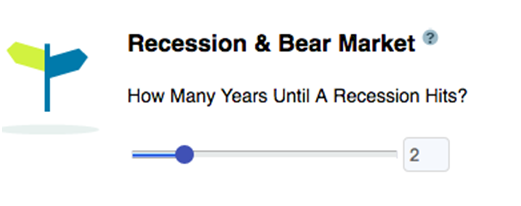
WealthTrace can run your portfolio through a bear market and show you how it could affect your retirement plans. Learn more.
In a short period of time, let’s say the portfolio loses 30% of its value. Living expenses, meanwhile, definitely do not go down by 30% over the same period. That initial 2% drawdown rate now jumps to more like 3% at exactly the wrong time. They’ll be pulling out money faster and faster just as the market has taken a big bite out of the account.
Pension To The Rescue
It can be a different story, however, if one or both of the plan participants have a pension.
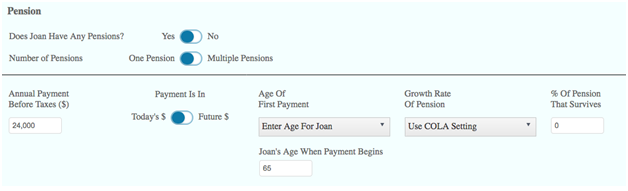
Pensions are less common than they used to be, but can make a big difference during the lean years of a retirement plan.
In this example, one person in the couple is projected to have $24,000 coming in via a pension--about what the couple would need to cover that 2% portfolio drawdown. Instead of pulling out portfolio principal when the market corrects, they can rely on the income from the pension.
Things To Consider With A Pension
WealthTrace can help you drill down into a retirement plan that accounts for pension income. You’ll want to know a few things before you get started inputting the information:
When does the payout start? Similar to Social Security, you might have some say about this (and the sooner you start to take the payments, the less it will be each year).
How much will the payout be to start with? See previous item--one likely depends on the other.
At what rate will the pension benefit grow (if it grows at all)? Sometimes pensions are indexed to inflation, sometimes not.
How much, if any, of the pension will continue to be paid out to the surviving spouse? Most likely, at least some portion of it will be paid out--the survivor’s benefit--in the event that the pensioner dies before his or her spouse does.
Is there a chance the pension will be reduced, or even disappear? This is a tricky one, and painful to contemplate. But industry landscapes change; pension funding projections can be too optimistic; the future is unknowable. It might make sense to trim back projected pension benefits a bit just to be conservative when putting your plan together.
Most retirees will take cash flows any way they can get them, but pensions are among the best ways. Count yourself fortunate if you have one--and make sure to account for it properly when putting your retirement plan together.
There is a lot more to a successful retirement plan than just hitting a number. You’ll want to WealthTrace covers all the bases. Learn more.
See beyond the $1 million benchmark
Use WealthTrace to determine what your own retirement plan actually requires.