Key Takeaways
Some investors convert from a traditional IRA to a Roth IRA without understanding whether or not they really should.
Usually the best time to convert to a Roth IRA is after retiring but before Social Security and Required Minimum Distributions (RMDs) begin.
A Roth conversion optimization tool makes this process much easier and can find the best conversion strategy quickly.
More people are retiring earlier than expected. The Covid pandemic was one reason a large number of people retired before they thought they would. Many of them have a large 401(k) balance to thank for this. Relatively early retirement combined with a large 401(k) or rollover IRA is opening up more opportunities to save money with a Roth conversion.
The Sweet Spot for Converting to a Roth IRA
The key to getting the most out of a Roth IRA conversion is to do it when your income tax rate is low. If a person stops working before he or she needs Social Security and there is no pension income, this is usually a great time for a Roth conversion because taxable income is so low. This assumes they don’t need large distributions from a 401(k) or traditional IRA in order to pay for expenses. These withdrawals would count toward taxable income and reduce the benefits of a Roth conversion.
Many people are shocked to see that their projected federal income tax rate in retirement is much lower than before they retired. Many times it’s close to 0%!
Let’s look at an example. Paul is 55 years old and both he and his wife have retired with a total of $2 million in their 401(k) plans. They have very little in their taxable accounts and plan on living off of their combined $45,000 in Social Security and their retirement accounts. They won’t take Social Security until they are both 67 so they have seven years until their income increases. Then at age 75 their RMDs will begin, at which point a Roth conversion definitely is less likely to make sense.
Using the Roth Conversion scenarios feature in the WealthTrace Planner I looked at a scenario where they convert part of their 401(k) plans into a Roth IRA starting today and stopping when their Social Security benefits begin at age 67. It is very unlikely they want to convert the entire $2 million because this would push them into a very high tax bracket during the entire conversion period. So I started by looking at what happens if they convert 30% of their 401(k)s.
The results show that a Roth conversion makes sense for them:

You can see that they would pay about $287,000 less in taxes over the life of their plan and the amount of money left at the end of their plan would be about $202,000 more. What if they converted half of the balance in the 401(k) plans?

The results get worse for them vs. the first scenario where they converted 30% to a Roth IRA. Although pay even less in taxes in this scenario, the amount they have left at the end of the plan was about $45,000 less than in the first scenario. This is because the large tax payments are very front-loaded when the Roth conversion is done.
Can Roth Conversions Actually Leave You With Less Money?
Roth conversions are often presented as a way to save taxes in retirement. But converting money from a traditional IRA or 401(k) to a Roth account doesn't automatically increase your wealth.
In fact, some Roth conversion strategies can leave you with less money.
The reason is that Roth conversions create taxable income in the year the conversion occurs. If you convert a large amount, you can push yourself into a higher federal or state income tax bracket. You could also trigger higher Medicare premiums or increase the taxation of other income.
Paying more taxes today can be worthwhile if it produces even greater benefits in the future. But that isn't always the case.
Consider a couple paying a 32% marginal federal tax rate on a conversion today who would otherwise withdraw that money at a 22% marginal rate in retirement. Unless other benefits offset that difference, the conversion could actually reduce their wealth even when they’re much older.
This is why simply trying to minimize future required minimum distributions or maximize the amount held in a Roth IRA can be misleading.
The more important question is whether a Roth conversion improves your long-term financial outcome after accounting for all the taxes and other costs involved.
That's why it's important to compare multiple conversion strategies rather than assuming that converting more money is always better.
How WealthTrace Finds an Optimized Roth Conversion Strategy
The examples above demonstrate how testing different Roth conversion amounts can lead to very different financial outcomes.
But there's a challenge with this approach: How do you know which conversion strategy is actually the best one?
You could manually test converting 10%, 20%, or 30% of your traditional retirement accounts. You could change the conversion period, compare different tax brackets, or test what happens if you begin converting later.
However, there are potentially thousands of combinations to consider.
WealthTrace's Roth Conversion Optimizer automates much of this process.
Instead of manually testing one strategy at a time, you can tell WealthTrace what you're trying to accomplish and let the software evaluate different conversion amounts and timing strategies across multiple years.
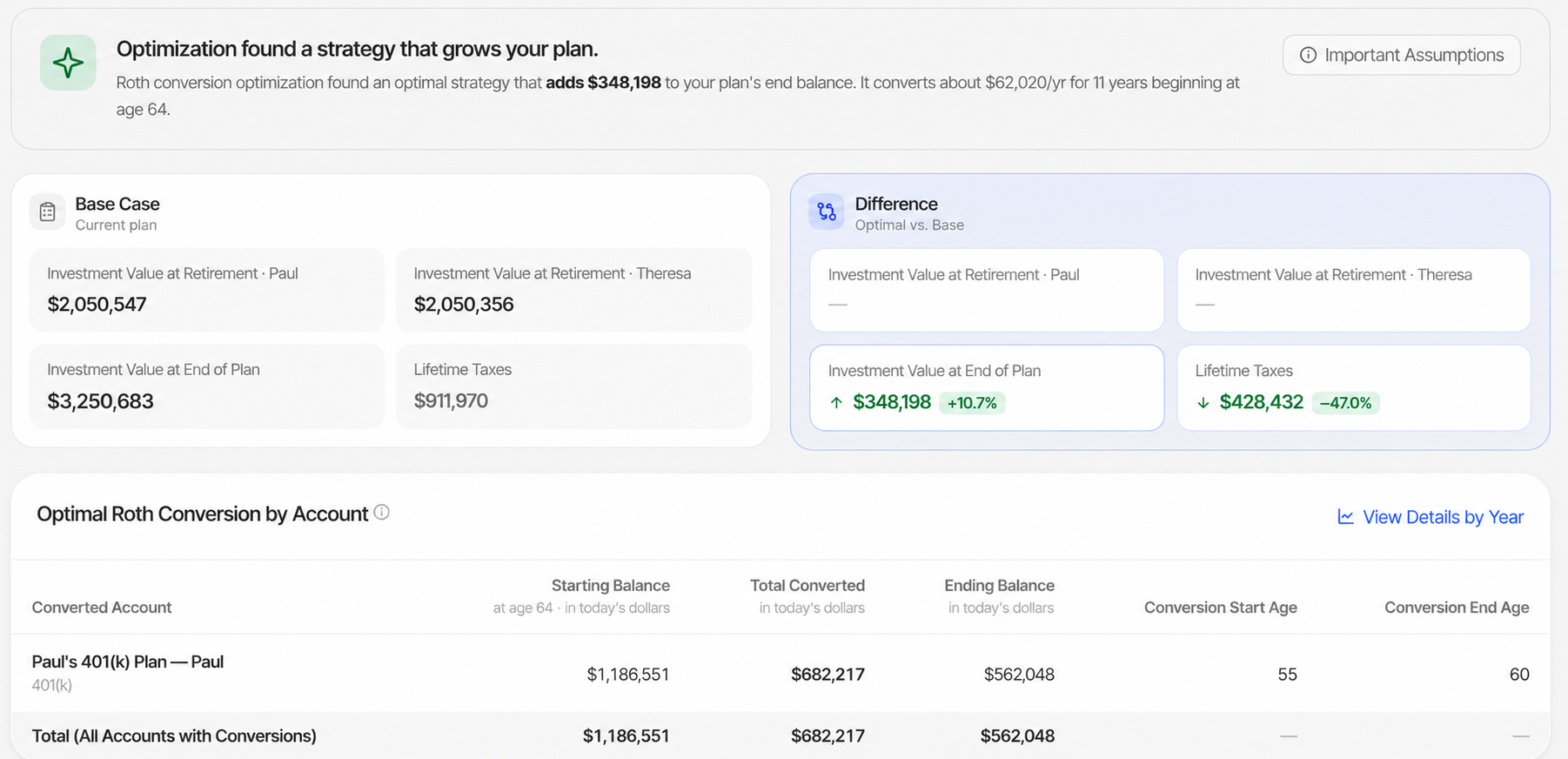
Choose what you want to optimize
WealthTrace allows you to select from three objectives:
Maximize ending investment value: Find a conversion strategy that seeks to increase your long-term after-tax wealth.
Minimize lifetime taxes: Identify conversion strategies that reduce projected taxes over your lifetime.
Maximize investment value for beneficiaries: Evaluate conversions based on the projected after-tax value of assets left to your heirs.
These objectives can produce different recommendations.
For example, the strategy that minimizes lifetime taxes may not be the one that leaves you with the most money at the end of retirement. Likewise, maximizing the amount your beneficiaries receive may favor a different conversion schedule.
Find your optimal Roth conversion strategy
See how different Roth conversion amounts and timing strategies could affect your taxes, retirement wealth, and the money you leave to heirs.
Start WealthTrace for freeAccount for important tax consequences
WealthTrace evaluates conversion strategies while modeling factors such as federal and state income taxes, Social Security taxation, capital gains, and potential Medicare IRMAA surcharges.
You can also establish constraints, including the ages during which conversions should occur and the maximum federal income tax bracket you're willing to reach.
The optimizer then compares possible strategies and identifies a conversion approach based on your selected objective and constraints.
Rather than trying to guess the ideal annual conversion amount, you can use WealthTrace to explore a data-driven strategy based on your own retirement plan.
Roth conversion optimization isn't simply about converting the most money or paying the least tax. It's about finding a strategy that best supports your financial goals.
Higher Potential Future Tax Rates
If you believe Congress will increase tax rates in the future, a Roth conversion makes even more sense if you can do it when your tax rates are lower and before your income tax rates go up. It’s very possible federal income tax rates go up in the near future due to the huge debt the federal government has. A tax increase can have a large impact on most retirement plans in general. But it also will sway decisions on Roth conversions.
How Medicare IRMAA Can Affect Roth Conversions
One Roth conversion cost that is easy to overlook is the potential impact on Medicare premiums.
Medicare uses income to determine whether you must pay an Income-Related Monthly Adjustment Amount, commonly known as IRMAA.
Roth conversions generally increase your modified adjusted gross income for the year. If the additional income pushes you above an IRMAA threshold, you could pay higher Medicare Part B and Part D premiums.
Medicare generally uses tax return information from two years earlier to determine these surcharges. That means a Roth conversion at age 63 could potentially affect your Medicare premiums at age 65.
For married couples, the additional premiums can apply to both spouses if they are both enrolled in Medicare and subject to the adjustment.
This doesn't mean you should automatically avoid a Roth conversion that triggers IRMAA. In some cases, paying higher Medicare premiums for a year or two may still be worthwhile if the conversion produces greater long-term benefits.
The important point is that IRMAA should be part of the conversion analysis, not an unexpected cost discovered afterward.
WealthTrace incorporates potential IRMAA effects into its Roth conversion modeling and optimization, allowing users to evaluate these tradeoffs as part of their retirement plan.
Life Expectancy and the Impact on Roth Conversions
One variable that doesn’t get much discussion when talking about Roth conversions is life expectancy. Many people don’t realize that the longer you think you will live, the more a Roth conversion makes sense. The reason is this: when a person who owns a Roth IRA lives longer, the amount in the Roth gets to grow and compound tax-free longer and there are no RMDs forcing the owner to withdraw the money.
Recall when we ran Roth conversion optimization, they had about $348,000 more left at the end of their plan if they followed the optimal conversion strategy. Currently their life expectancy is set to 85 years. What if we set it to 92?
After changing the life expectancy assumption and re-running the Roth conversion scenario we see the results below:
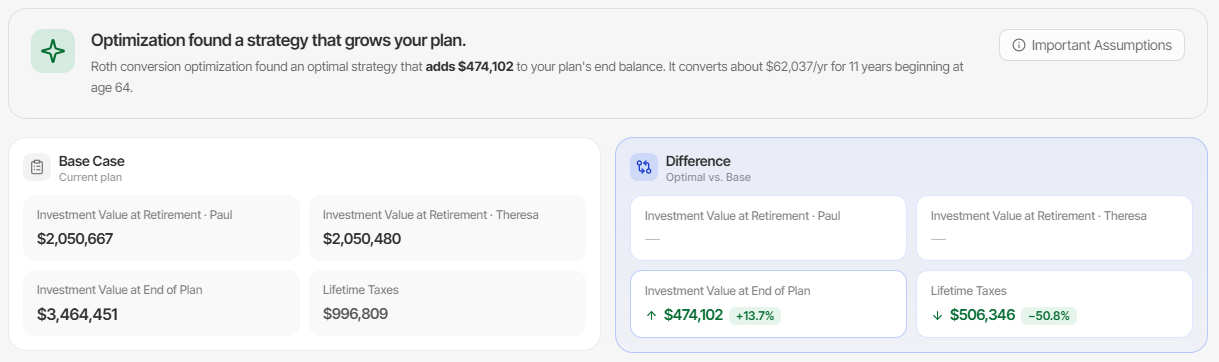
Because they live longer they have less money at the end of their plan. But notice how much more is left if they convert to a Roth IRA now. They would have nearly $475,000 more, which is about 43% more than when their life expectancy was 85. This just shows how important the life expectancy variable is for Roth IRA conversions and for retirement planning in general.
Why the Best Roth Conversion Strategy Depends on Your Goals
A Roth conversion strategy can accomplish more than lowering projected lifetime taxes.
For example, consider a married couple whose primary goal is maximizing the money they have available during retirement. Their best conversion strategy may be different from that of a couple who wants to leave the largest possible after-tax inheritance to their children.
Roth accounts can be particularly valuable for beneficiaries because qualified withdrawals are generally tax-free. Many non-spouse beneficiaries must empty inherited retirement accounts within ten years, although the distribution requirements differ depending on the type of account and beneficiary.
A larger Roth inheritance may reduce the income taxes heirs would otherwise face on distributions from inherited traditional retirement accounts.
Roth conversions can also help manage the potential tax consequences when one spouse dies. The surviving spouse may eventually face less favorable income tax brackets when filing as a single taxpayer.
Finally, some investors consider Roth conversions a way to reduce their exposure to possible future tax increases.
These benefits are difficult to evaluate by looking at only one year's tax bracket.
The most useful Roth conversion analysis considers your entire retirement plan, your tax situation over time, and what you ultimately want to accomplish with your money.
Finding the Right Roth Conversion Strategy
Roth conversions can provide major long-term benefits, but the right strategy depends on much more than your current income tax bracket.
Timing, conversion amounts, future tax rates, Medicare premiums, investment returns, and estate planning goals can all influence the outcome.
In some cases, converting large amounts over several years can improve your financial position. In others, smaller conversions—or no conversions at all—might be the better choice.
WealthTrace allows you to test Roth conversion scenarios manually or use its Roth Conversion Optimizer to compare different strategies based on your financial goals.
The goal isn't simply to pay less in taxes. It's to make informed decisions that improve your overall retirement plan.
Plan your Roth conversion strategy
Use WealthTrace to evaluate taxes, future RMDs, and long-term outcomes before converting.