Key Takeaways
This analysis runs thousands of scenarios and gives you the probability of a certain event occurring or not occurring. You can sign up for a free trial of WealthTrace, which has the most accurate Monte Carlo retirement simulations for consumers on the market, to calculate your probability of never running out of money.
Applied properly to retirement plans, the WealthTrace Monte Carlo retirement calculator is a powerful tool to help you figure out when you can retire comfortably.
Models like Monte Carlo are garbage in, garbage out. The assumptions must be based on reality and history.
We all look at the weather forecast from time to time. Some of us look every day. But how many of us ask the question, "Will it rain tomorrow or not?"
That is not the question most of us are asking. We almost instinctively ask, "What is the probability of rain tomorrow?"
Monte Carlo Calculator For Weather
We almost take for granted what goes into a weather forecast that says there is a 10% chance of rain tomorrow. But behind the scenes there are very powerful computers running Monte Carlo simulations, using hundreds of variables that impact the weather.
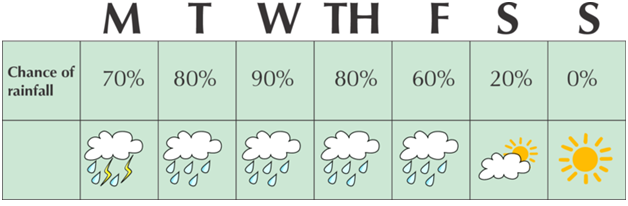
These weather models are run using thousands of scenarios. The number of times it rains in these scenarios is then divided by the number of scenarios run. This gives us the probability that it will rain.
Monte Carlo Simulation For Retirement
The analogy for retirement is this: Do you really want to ask "Will I outlive my money in retirement or not?" You can ask that, but what you also need to be asking is "What is the probability that I do not outlive my money in retirement?"
Just like any modeling process, Monte Carlo retirement simulations are garbage in-garbage out. There are a few Monte Carlo retirement calculators out there that take in a few basic assumptions and spit out the probability of success, which usually means you do not run out of money at any point.
Most of these calculators do not dig deep into your own personal situation and information. But if the Monte Carlo retirement calculator doesn't take into account you actual assets, correct tax rates, historical volatility of your investments, the correlations among your investment types, and all of your other retirement income sources, the answer it gives won't be worth much.
How Does Monte Carlo Retirement Analysis Work?
Monte Carlo analysis is a method of estimating how a retirement plan might perform under thousands of different investment return scenarios. Instead of assuming your investments earn the same return every year, it models many possible sequences of market gains and losses.
This matters because the order of investment returns can be just as important as the average return.
Consider two retirees who each begin retirement with $1 million. Both portfolios earn the same average annual return over 20 years, but one experiences a severe market decline during the first few years of retirement while the other experiences strong returns early on.
If both retirees are withdrawing money to cover living expenses, their ending balances can be very different. The retiree who experiences losses early may have to sell investments at depressed prices, leaving less money available to benefit from a recovery.
This is known as sequence-of-returns risk, and it is one of the most important risks facing retirees.
Monte Carlo analysis helps reveal this risk by testing many possible market paths rather than relying on a single average-return projection.
In WealthTrace, 1,000 simulations are run using varying annual investment returns. Each simulation tests whether the plan can continue funding its projected financial needs throughout retirement.
The result is a probability of retirement success, along with a range of potential investment outcomes.
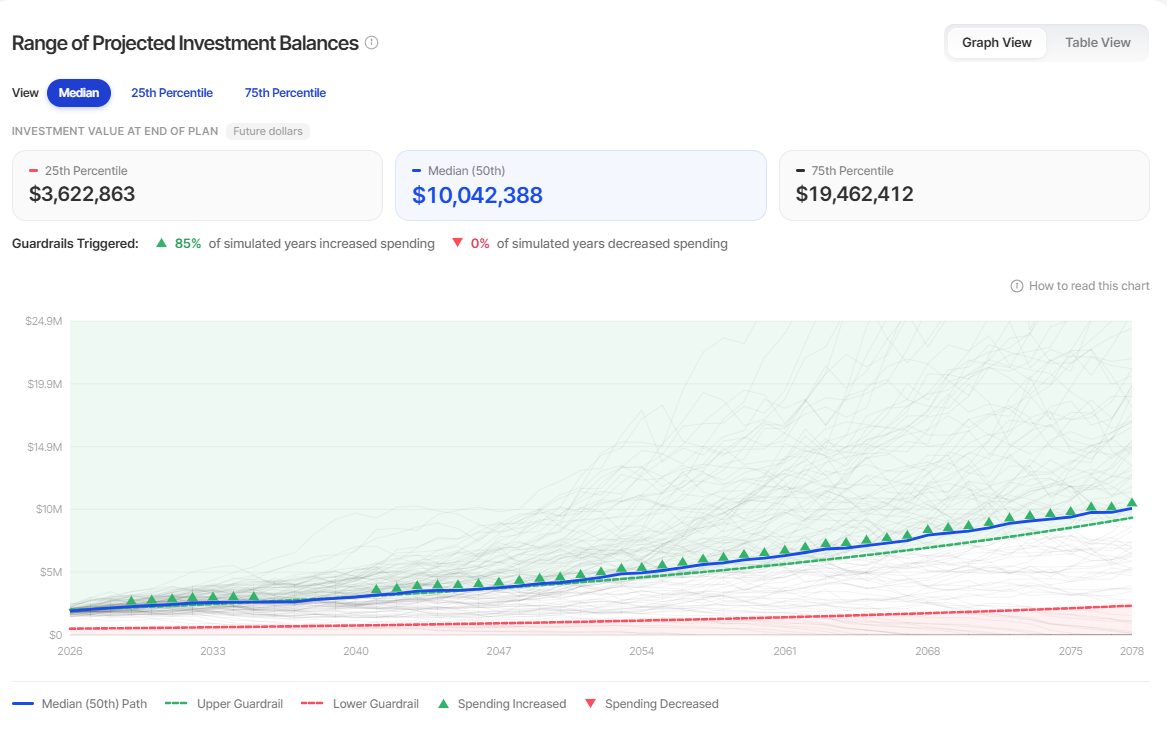
How Accurate Are Monte Carlo Retirement Simulations?
Monte Carlo simulations can provide valuable insight into retirement risk, but their accuracy depends heavily on the assumptions used.
Running more simulations does not automatically make a retirement calculator more accurate. A calculator that runs 10,000 simulations using unrealistic assumptions can actually produce less useful results than one that runs 1,000 simulations using assumptions that better reflect your financial situation.
Several factors can affect the results:
Expected investment returns: Assuming returns that are too high can make a retirement plan look stronger than it really is.
Investment volatility: Stocks, bonds, and other investments experience different levels of price fluctuation. These differences affect the range of possible outcomes.
Investment correlations: Investments do not always move independently. Understanding how asset classes move together is essential when modeling portfolio risk.
Inflation: Higher-than-expected inflation can substantially increase the cost of funding retirement expenses.
Taxes: Withdrawals from traditional retirement accounts, taxable investments, and Roth accounts can have very different tax consequences.
Retirement spending: A plan that assumes constant spending may produce different results from one that allows spending to change with market conditions.
Longevity: Funding retirement through age 95 presents a different challenge from planning through age 85.
There is another important limitation: Monte Carlo analysis cannot predict future market returns or guarantee a particular retirement outcome.
A probability of success is an estimate based on the model's assumptions, not a promise about what will happen.
The most useful approach is to run simulations using realistic financial inputs, examine a range of outcomes, and update the analysis as your circumstances change.
Why Your Actual Investment Holdings Matter in Monte Carlo Analysis
Many retirement calculators begin by asking what percentage of your portfolio is invested in stocks and bonds. They then apply assumed returns and volatility to those broad categories.
That can provide a useful starting point, but it may overlook important differences between portfolios.
For example, two investors could both have 70% of their portfolios invested in stocks and 30% in bonds. However, one might hold a diversified mix of U.S. stocks, international stocks, and high-quality bonds, while the other has a concentrated position in large-cap growth stocks and long-term bonds.
Even though both portfolios have the same overall stock-and-bond allocation, their underlying risk characteristics can be very different.
This is why portfolio composition matters in Monte Carlo analysis.
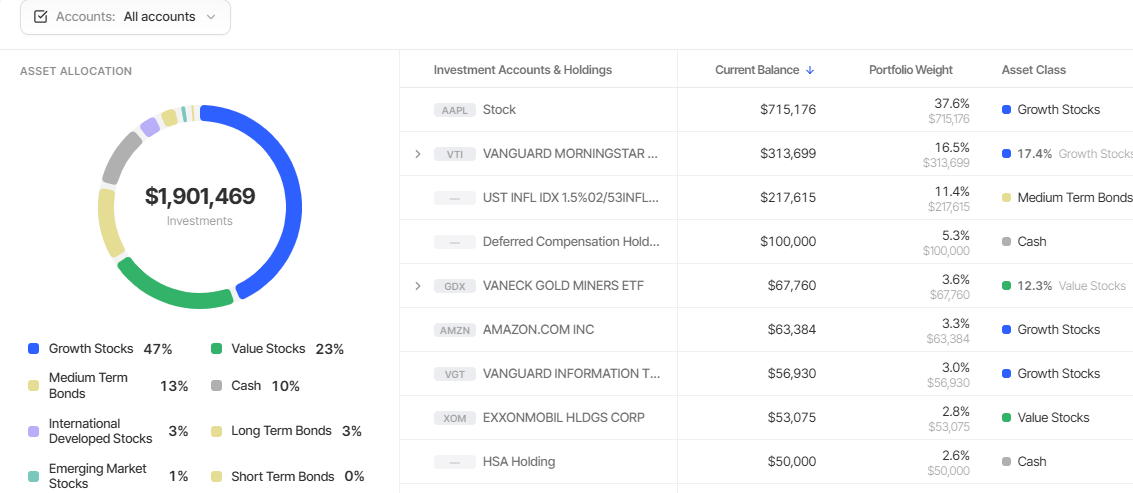
WealthTrace can use actual investment holdings and their mapped asset classes to build more detailed return and risk assumptions. Its Monte Carlo simulations incorporate investment volatility and correlations, helping users understand how their particular portfolio may behave across different market environments.
A retirement plan should reflect more than how much money you have saved. It should also consider how that money is invested and how those investments may perform together during good and bad markets.
Holistic Monte Carlo Retirement Simulations
In order to get an accurate assessment of your probability of never running out of money, you need accurate retirement planning software. Our customers use the WealthTrace Financial & Retirement Planner to get an accurate view of their retirement situation, including their probability of plan success. You can use our software for free by starting here.
In our retirement planning software we take into account the following:
Historical volatility of all major investment types
Historical correlation among the investments
Historical rates of return for investments
Changing taxes over time using up to date tax laws
Other income sources such as social security and pensions
Different account types such as Traditional IRAs, Roth IRAs, 401(k)s, 529 plans, tax-free accounts, and many other variables that impact your financial plan.
Our Monte Carlo retirement calculator runs 1,000 scenarios where the rates of return for every investment changes in each year. We take the number of scenarios where money never runs out in retirement and divide it by 1,000 to find the probability of success (never running out of money).
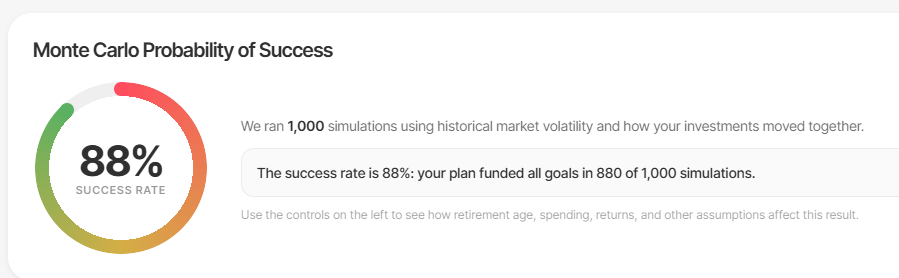
In this example this person has an 88% chance of never running out of money. Also unique to WealthTrace is that the program shows the probability through any given year. This is nice to have as it shows the probability of never running out of money as your life expectancy increases.
The Bottom Line
Using quick and easy calculators can be completely fine for a first pass at retirement and financial planning questions. But it's very important not to make serious decisions about your retirement plan based on simple calculators. You want to use a Monte Carlo retirement calculator that is powerful, accurate, and assesses your actual situation and investments.
What is your probability of never outliving your money? WealthTrace can give you that answer. Use a free trial of WealthTrace to calculate your probability of retirement success.
Put your retirement plan to the test
WealthTrace uses realistic market and financial assumptions to measure your plan's resilience.