3 Key Takeaways
Don't overlook year-end deadlines. Roth conversions, most employee 401(k) contributions, and required minimum distributions generally must be completed by December 31 to count for 2026.
Take advantage of tax-saving opportunities. Roth conversions, tax-loss harvesting, and charitable giving strategies offer ways to manage your tax liability before the year ends.
Prepare your retirement plan for 2027. Reviewing your investments, income, expenses, and retirement projections helps ensure your financial plan reflects your current circumstances.
7 Smart Financial Moves to Make Before December 31, 2026
As 2026 comes to a close, now is a good time to review your finances and identify opportunities to improve your retirement outlook. From maximizing retirement contributions to making strategic tax decisions, the steps you take before year-end can have a lasting impact on your financial future.
While some deadlines extend into 2027, several important opportunities end on December 31. Here are seven financial moves worth reviewing before the new year begins.
1. Maximize Your Retirement Contributions
If you're still working, review your retirement contributions to see whether you have room to increase your savings before year-end. The IRS raised contribution limits for 2026, allowing individuals to save more through 401(k)s, IRAs, and other retirement accounts.
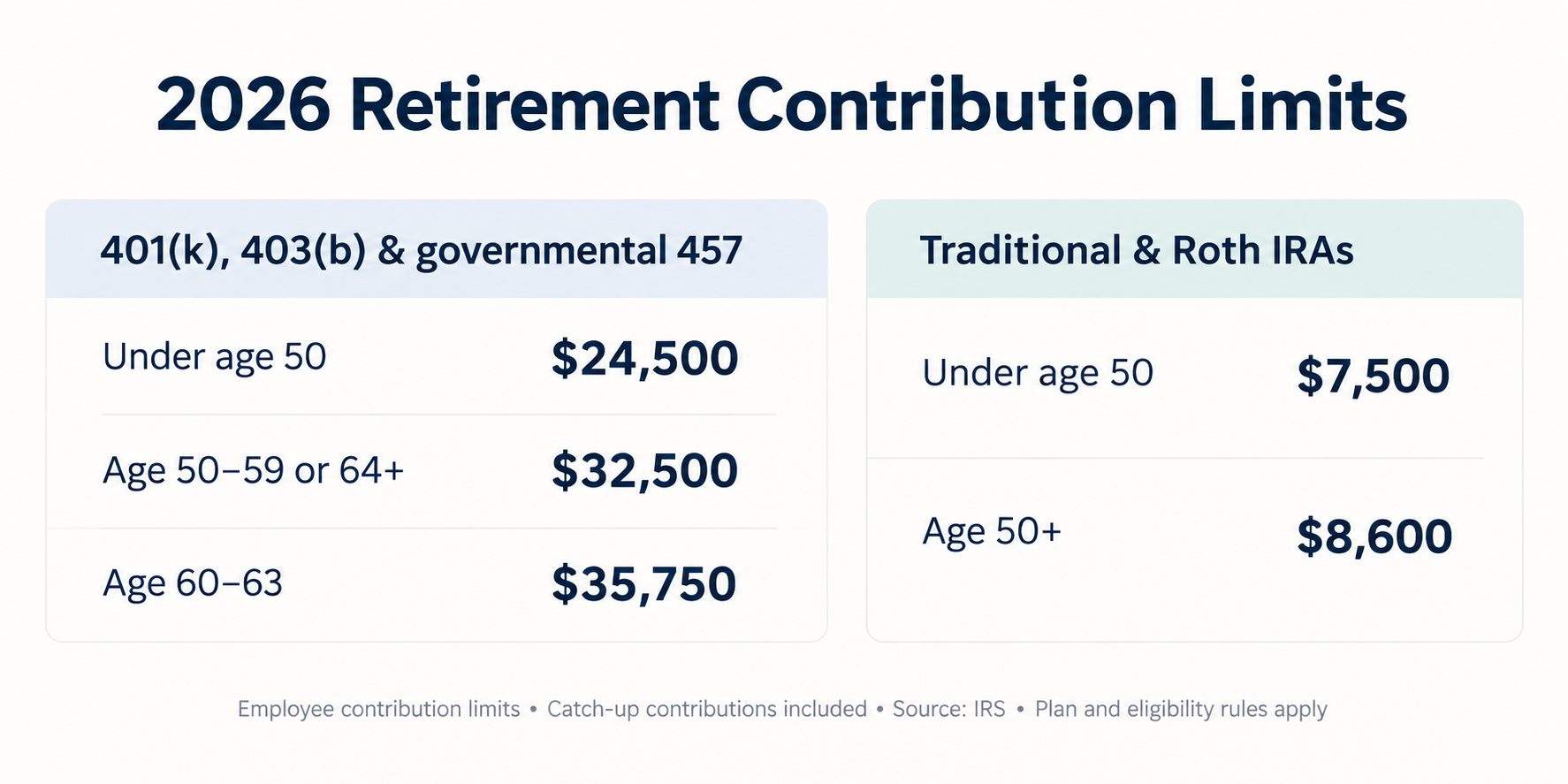
If you haven't reached your contribution limit, increasing contributions during your remaining pay periods helps you take advantage of this year's savings opportunities. It's also worth confirming that you're contributing enough to receive your employer's full matching contribution.
Important deadline: Employee 401(k) contributions generally must be made by December 31, while eligible taxpayers have until April 15, 2027, to make IRA contributions for the 2026 tax year.
2. Consider a Roth Conversion Before Year-End
A Roth conversion moves money from a traditional IRA or another eligible pre-tax retirement account into a Roth account. Although the converted amount is generally taxable in the year of conversion, qualified Roth withdrawals are tax-free, making this an effective strategy for managing retirement taxes over time.
Year-end is a good opportunity to evaluate a conversion because you have a clearer picture of your annual income. For example, someone who recently retired or experienced a lower-income year might benefit from converting funds while in a lower tax bracket. However, converting too much at once can push income into a higher bracket, increase taxable Social Security benefits, or trigger higher Medicare premiums.
Important deadline: Roth conversions must be completed by December 31 to count for the 2026 tax year.
3. Review Your Investments for Tax-Loss Harvesting Opportunities
If you have investments in a taxable brokerage account, reviewing your realized gains and losses before year-end can help identify opportunities to reduce your tax liability. Tax-loss harvesting involves selling investments at a loss to offset taxable capital gains from other investments.
For example, if you realized $10,000 in capital gains earlier this year and sell an investment with a $4,000 loss, your net taxable capital gains decrease to $6,000. If your losses exceed your gains, you can generally deduct up to $3,000 against ordinary income annually ($1,500 if married filing separately), with remaining losses carried forward to future years.
Be mindful of the wash-sale rule, which generally disallows an immediate loss deduction if you purchase substantially identical securities within 30 days before or after the sale. This strategy applies to taxable investment accounts rather than investments held within IRAs or 401(k)s.
4. Make Sure You've Taken Your Required Minimum Distributions
If you're age 73 or older, confirm whether you've satisfied your required minimum distributions (RMDs) for 2026. These mandatory withdrawals apply to certain tax-deferred retirement accounts, including traditional IRAs and 401(k)s, and are generally calculated using your previous year-end account balance and an IRS life expectancy factor.
Most RMDs must be taken by December 31, although individuals in their first RMD year can generally delay their initial distribution until April 1 of the following year. Choosing to delay means taking two RMDs in 2027, increasing taxable income for that year.
Failing to take an RMD generally results in a 25% excise tax on the shortfall, reduced to 10% if corrected within the required period. The IRS also provides a process for requesting a penalty waiver when an error is properly corrected.
Make sure your retirement plan is ready for 2027.
WealthTrace helps you review your retirement projections, evaluate Roth conversions, explore tax-saving strategies, and see how year-end financial decisions could impact your long-term retirement plan.
Make more informed decisions before the year ends.
5. Take Advantage of Charitable Giving Strategies
If charitable giving is part of your financial plan, reviewing your donations before year-end can help you take advantage of available tax benefits. Beginning in 2026, eligible taxpayers who take the standard deduction can deduct up to $1,000 in qualifying cash charitable contributions, or $2,000 for married couples filing jointly. Taxpayers who itemize are generally subject to a new charitable deduction floor of 0.5% of adjusted gross income.
For retirees age 70½ and older, qualified charitable distributions (QCDs) offer another tax-efficient strategy. These allow funds to be transferred directly from an IRA to an eligible charity without including the qualifying distribution in taxable income, and they can also satisfy RMD requirements when applicable.
Donating appreciated investments directly to charity is another option worth considering. This approach generally avoids realizing capital gains on the donated securities, while the available charitable deduction depends on the applicable tax rules and eligibility requirements.
6. Review Your Investment Allocation
Market performance throughout the year can gradually shift your portfolio away from its intended allocation, changing your investment risk without you making any trades. For example, a portfolio that started the year with 60% stocks and 40% bonds might now hold 68% stocks and 32% bonds following strong stock market performance.
This increased stock exposure is especially important for those approaching retirement, when managing investment risk becomes a greater priority. Review whether your portfolio still aligns with your retirement timeline, risk tolerance, and income needs, and consider rebalancing if your allocation has drifted significantly.
Keep in mind that selling appreciated investments in taxable accounts can generate capital gains, while trades within tax-advantaged retirement accounts generally don't trigger immediate capital gains taxes.
7. Run a Year-End Retirement Plan Checkup
One of the most valuable financial moves you can make before year-end is to review your retirement plan and understand how today's decisions affect your financial future. Changes to your investments, income, spending, and retirement timeline can significantly impact your long-term outlook, making it important to see how these factors work together.
With WealthTrace, you can build a comprehensive retirement plan and model different financial scenarios before making important decisions. See how Roth conversions affect your future taxes, explore different retirement dates, adjust your investment allocation, or evaluate how changes to your spending impact your retirement savings. WealthTrace also projects your future cash flow, Social Security income, required minimum distributions, and taxes, giving you a clearer picture of your finances throughout retirement.
Rather than guessing which financial moves make the most sense, you can compare scenarios and see their impact on your retirement plan. Start your free WealthTrace trial and head into 2027 with a better understanding of your financial future.
Your 2026 Year-End Financial Checklist
Before December 31, review these seven items:
Maximize eligible retirement contributions.
Evaluate Roth conversion opportunities.
Review taxable investments for potential losses.
Confirm required minimum distributions are satisfied.
Review charitable giving strategies.
Rebalance your investment portfolio if needed.
Update your retirement plan for 2027.
Remember that not every financial deadline falls on December 31. Confirm applicable contribution and processing deadlines with your financial institutions.
See how today's financial decisions impact your retirement.
Use WealthTrace to test Roth conversions, adjust your investment strategy, and explore how changes to your income, taxes, and spending affect your long-term retirement plan.